Showing posts with label Picture Books. Show all posts
Monday, June 27, 2016
Emmanuel's Dream: The True Story of Emmanuel Ofosu Yeboah
Emmanuel's Dream: The True Story of Emmanuel Ofosu Yeboah
by Laurie Ann Thomson Illustrated by Sean Qualls
This post and the prior one, Last Stop on Market Street, were prepared in draft this past spring after visiting my granddaughters in Baton Rouge. A search for quality titles to take to them reaped the last one for Lucy (preschool) and this one for Evie (kindergarten). Summer time affords time to publish these wonderful stories selected as literature for building character. "Building character" is one way of saying that we are growing our potential for virtue throughout our entire lives.
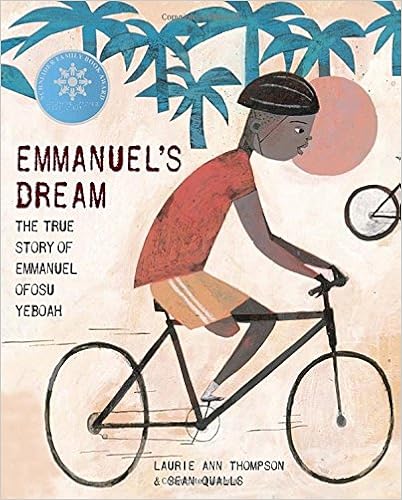
On the first page we meet the boy:
"In Ghana, West Africa, a baby boy was born:
two bright eyes blinked in the light,
two healthy lungs let out a powerful cry,
two tiny fists opened and closed,
but only one strong leg kicked."
To preview this book, I suggest you do as I did and take a "look inside" on the Amazon website entry of this title. From the beginning of his story, the reader can see that Emmanuel's mother instilled the courage and determination that would flourish as he grew.
"As Emmanuel grew,
Mama Comfort told him he could have anything,
but he would have to get it for himself."
I was hooked after reading the editorial review from School Library Journal:
"K-Gr 2�This powerful and winning picture book tells the story of a young man overcoming the odds. Born in Ghana with a deformed left leg, Emmanuel Ofosu Yeboah experienced stigma as a result of his disability: his father abandoned the family, and many assumed that the boy would be little more than a burden. However, with the encouragement of his mother, Yeboah refused to give up, hopping to school (instead of walking) and even learning to play soccer and cycle, despite receiving no extra help or accommodations. Thompson's lucidly written text explains how Yeboah cycled 400 miles in 2001 to raise awareness, forever changing how Ghanaians perceived those with disabilities. The narrative is simply and clearly written, and the illustrations are skillfully rendered in charmingly emotive ink and watercolor collages. A brief author's note explains how Yeboah inspired legislation upholding equal rights for the disabled and how he continues to make strides, working with organizations that provide wheelchairs to those who need them and setting up a scholarship fund for children with disabilities. VERDICT This uplifting account will resonate with readers and supplement global and cultural studies. A triumph.�Kathryn Diman, Bass Harbor Memorial Library, Bernard, ME"
Of course, this picture book is for ALL ages. It was made into an inspiring documentary film narrated by Oprah Winfrey. At the onset of the trailer, viewers hear Emmanuel's voice:
"To set a goal is an honorable and noble thing to do. To complete a goal is even more noble."
Of course, this picture book is for ALL ages. It was made into an inspiring documentary film narrated by Oprah Winfrey. At the onset of the trailer, viewers hear Emmanuel's voice:
"To set a goal is an honorable and noble thing to do. To complete a goal is even more noble."
The clip ends with "Don't say...thank God I'm not like him, but say...perhaps I can be more like him."
Oprah then says, "This is the story of boy who had nothing - but gave everything - and changed a nation forever."
The movie clip is 2:35 minutes long and would be appropriate to view with elementary and junior high students, hand-in-hand with the reading of the book. The full documentary is rated "G" and is 80 minutes long. Here is the you tube link for the clip.
https://youtu.be/gB0BD5l8Ojc
Last Stop on Market Street
Last Stop on Market Street
By Matt de la Pina Illustrated by Christian Robinson
This post and the one to follow were prepared in draft this past spring after visiting my granddaughters in Baton Rouge. A search for quality titles to take to them reaped this one for Lucy (preschool) and the next one for Evie (kindergarten). This grandma and reading teacher always gets behind in publishing, but rest assured these blog posts about quality literature which builds character will continue to spill out for years to come. If you "follow" the blog you will catch the posts!
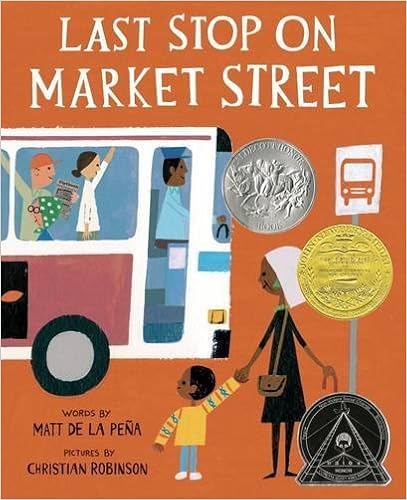
Wow! Take a look at the awards this recent picture book received! You may be familiar with the best illustrated book of the year that is awarded the Caldecott Medal. This received both a Caldecott Honor award and a Coretta Scott King honor award for its illustrations. Yet, this title ALSO was the winner of the best book written for children, the Newbery. Usually given to novels for ~ grades 3 - 9, this is a stunning achievement for a picture book. School Library Journal recommends it for grades K-2, but Lucy, a preschooler, was touched by the message, and I know that it will resonate with students up through eighth grade and beyond - including adults. Please read and share this book with anyone!
The review from School Library Journal portrays the layers of meaning in the simple plot:
After church on Sundays, CJ and his nana wait for the bus. It's a familiar routine, but this week CJ is feeling dissatisfied. As they travel to their destination, the boy asks a series of questions: "How come we gotta wait for the bus in all this wet?" "Nana, how come we don't got a car?" "How come we always gotta go here after church?" CJ is envious of kids with cars, iPods, and more freedom than he has. With each question, Nana points out something for CJ to appreciate about his life: "Boy, what do we need a car for? We got a bus that breathes fire." These gentle admonishments are phrased as questions or observations rather than direct answers so that CJ is able to take ownership of his feelings. After they exit the bus, CJ wonders why this part of town is so run-down, prompting Nana to reply, "Sometimes when you're surrounded by dirt, CJ, you're a better witness for what's beautiful." The urban setting is truly reflective, showing people with different skin colors, body types, abilities, ages, and classes in a natural and authentic manner. Robinson's flat, blocky illustrations are simple and well composed, seemingly spare but peppered with tiny, interesting details. Ultimately, their destination is a soup kitchen, and CJ is glad to be there. This is an excellent book that highlights less popular topics such as urban life, volunteerism, and thankfulness, with people of color as the main characters. A lovely title.�Anna Haase Krueger, Ramsey County Library, MN
And here is the string of awards:
Winner of the 2016 Newbery Medal
A 2016 Caldecott Honor Book
A 2016 Coretta Scott King Illustrator Honor Book
A New York Times Bestseller
A New York Times Book Review Notable Children�s Book of 2015
An NPR Best Book of 2015
A Kirkus Reviews Best Book of 2015
A Wall Street Journal Best Book of 2015
A 2015 Publishers Weekly Best Book of the Year
A Horn Book Best Book of 2015
BookPage�s �2015�s First Must-Read Picture Book�
The Huffington Post Best Overall Picture Book of 2015
A Boston Globe Best Book of 2015
A Chicago Public Library Best Book of 2015
Chosen for the New York Public Library�s 100 Books for Reading & Sharing List
A Miami Herald Best Children�s Book of 2015
A Raleigh News & Observer Best Children�s Book of 2015
An Atlanta Parent Best Book of 2015
A San Francisco Chronicle Holiday Gift Guide Pick
A Center for the Study of Multicultural Children�s Literature �Best Multicultural Books of 2015� Pick
A Scholastic Instructor 50 Best Summer Book
Chosen for the ALSC 2015 Summer Reading List
A Horn Book Summer 2015 Reading List Pick
Chosen for School Library Journal�s 2015 Top 10 Latin Books List
A Kansas City Star Thanksgiving 2015 Roundup Pick
A Winter 2014-2015 Kids' Indie Next Pick
2015 E.B. White Read Aloud Award Finalist
Nominated for the 2016 Washington Children�s Choice Picture Book Award
Nominated for the 2016 Kentucky Bluegrass Award
By Matt de la Pina Illustrated by Christian Robinson
This post and the one to follow were prepared in draft this past spring after visiting my granddaughters in Baton Rouge. A search for quality titles to take to them reaped this one for Lucy (preschool) and the next one for Evie (kindergarten). This grandma and reading teacher always gets behind in publishing, but rest assured these blog posts about quality literature which builds character will continue to spill out for years to come. If you "follow" the blog you will catch the posts!
Wow! Take a look at the awards this recent picture book received! You may be familiar with the best illustrated book of the year that is awarded the Caldecott Medal. This received both a Caldecott Honor award and a Coretta Scott King honor award for its illustrations. Yet, this title ALSO was the winner of the best book written for children, the Newbery. Usually given to novels for ~ grades 3 - 9, this is a stunning achievement for a picture book. School Library Journal recommends it for grades K-2, but Lucy, a preschooler, was touched by the message, and I know that it will resonate with students up through eighth grade and beyond - including adults. Please read and share this book with anyone!
The review from School Library Journal portrays the layers of meaning in the simple plot:
After church on Sundays, CJ and his nana wait for the bus. It's a familiar routine, but this week CJ is feeling dissatisfied. As they travel to their destination, the boy asks a series of questions: "How come we gotta wait for the bus in all this wet?" "Nana, how come we don't got a car?" "How come we always gotta go here after church?" CJ is envious of kids with cars, iPods, and more freedom than he has. With each question, Nana points out something for CJ to appreciate about his life: "Boy, what do we need a car for? We got a bus that breathes fire." These gentle admonishments are phrased as questions or observations rather than direct answers so that CJ is able to take ownership of his feelings. After they exit the bus, CJ wonders why this part of town is so run-down, prompting Nana to reply, "Sometimes when you're surrounded by dirt, CJ, you're a better witness for what's beautiful." The urban setting is truly reflective, showing people with different skin colors, body types, abilities, ages, and classes in a natural and authentic manner. Robinson's flat, blocky illustrations are simple and well composed, seemingly spare but peppered with tiny, interesting details. Ultimately, their destination is a soup kitchen, and CJ is glad to be there. This is an excellent book that highlights less popular topics such as urban life, volunteerism, and thankfulness, with people of color as the main characters. A lovely title.�Anna Haase Krueger, Ramsey County Library, MN
And here is the string of awards:
Winner of the 2016 Newbery Medal
A 2016 Caldecott Honor Book
A 2016 Coretta Scott King Illustrator Honor Book
A New York Times Bestseller
A New York Times Book Review Notable Children�s Book of 2015
An NPR Best Book of 2015
A Kirkus Reviews Best Book of 2015
A Wall Street Journal Best Book of 2015
A 2015 Publishers Weekly Best Book of the Year
A Horn Book Best Book of 2015
BookPage�s �2015�s First Must-Read Picture Book�
The Huffington Post Best Overall Picture Book of 2015
A Boston Globe Best Book of 2015
A Chicago Public Library Best Book of 2015
Chosen for the New York Public Library�s 100 Books for Reading & Sharing List
A Miami Herald Best Children�s Book of 2015
A Raleigh News & Observer Best Children�s Book of 2015
An Atlanta Parent Best Book of 2015
A San Francisco Chronicle Holiday Gift Guide Pick
A Center for the Study of Multicultural Children�s Literature �Best Multicultural Books of 2015� Pick
A Scholastic Instructor 50 Best Summer Book
Chosen for the ALSC 2015 Summer Reading List
A Horn Book Summer 2015 Reading List Pick
Chosen for School Library Journal�s 2015 Top 10 Latin Books List
A Kansas City Star Thanksgiving 2015 Roundup Pick
A Winter 2014-2015 Kids' Indie Next Pick
2015 E.B. White Read Aloud Award Finalist
Nominated for the 2016 Washington Children�s Choice Picture Book Award
Nominated for the 2016 Kentucky Bluegrass Award
Tuesday, September 1, 2015
The First Days: What Do Our Classroom Libraries Say to Young Readers?
 |
| This is one section of a my classroom library which displayed favorite characters. (This section was developed with students after the first day.) |
The first days with our library are just the beginning. After the first days I'll want the students to grow the library. I'll want them to consider the books we need, the categories for our baskets, and the best locations for particular collections, but from the first moment they walk into the classroom I want them to know literature is valued here. In those first days I hope they'll discover books that will speak to them and see their reflection in the books that surround us each day.
My love for picture books in my classroom has carried over to my work with young readers in intervention. Even in the reading room I work to create a library for readers. Most often, I'm working with readers in their classrooms, but I want my reading room to have books available for students to browse. My space is small; last year having books displayed was continually a challenge. This year I decided to do an even deeper clean to make space for more book displays. I wanted to be able to have baskets of books for students. I wanted to be able to have picture books they'd love, but also a greater collection of picture books I thought they could read independently. My first collections include books about reading and writing, wordless picture books, easy informational reads, and song books. I have a space for authors which includes Todd Parr, Jan Thomas, and Mo Willems to begin.
Getting Our Library Started
In the first days, I hope my classroom library will say:
You're welcome here: As students sit down to read in the first days, I want them to be able to see themselves in our library. Over the years I've worked to include more diverse characters. Though possibilities for diverse characters are growing, it's still hard work to find titles with strong characters.
All readers matter: Working with young readers I want students to be able to come into the classroom and find a book they can read. If books are all too challenging, a child may begin to see himself or herself as someone who can't read. I want every basket of books to contain titles students will be able to read and enjoy. This means thinking about where students are coming in at the beginning of the year instead of where I expect them to be or where they will finish the year as readers.
I already know you: As I put my library together I consider titles students will remember from their previous year. As a first grade teacher, I knew students would come in knowing Mo Willems characters, having read Mrs. Wishy-Washy and Dan the Flying Man. I try to include books in our library I know students will remember from the previous year. I also try to consider topics I think students will be interested in reading more about at the beginning of the year. It seems I can't go wrong with books about pets, friends, and school in the first days.
Books are valued here: When students walk into the classroom I want them to feel surrounded by books. I place books around the room. This not only helps in the first days of workshop as students learn to spend time reading books, but it also sends the message the reading is valued here. My goal is for students to be able to sit most anywhere and reach a book.
We'll grow this together: The first days require a delicate balance. I want there to be enough books for students to get started reading, but I also want them to know we'll grow the library together. For this reason, I leave out empty baskets and save space on shelves for the titles our new learning community would like to add.
Come read with me: By arranging books in an appealing way our libraries will not only surround us, but will call to students. Front covers facing out, picture books featured in spaces and placed within reach, will invite readers to sit down and spend some time reading. Cozy spaces near book displays will also encourage students to pick up a book and read.

What do our classroom libraries say to young readers? Share images of your favorite library spaces at the hashtag #classroomlibrary.
Thursday, March 20, 2014
The Tower
The Tower
Richard Paul Evans
This fable set in China was chosen by our second grade teacher, Mr. Sprau who has an eye for literature that builds character. It was read with Amber on the Mountain (see blog post March 13) for a series of morning openings on the theme of helpfulness. A man seeks to be the greatest in the kingdom so he builds a high tower. He has taken the advice literally that people who "look up to him" will think he is great. However, one day a bird tells him an old woman is greater than he is. Of course, this is a challenge to him so he seeks her out. She tells him that she not only thinks he is not great, but that she pities him.
�I pity him because I think he must be miserable. He spends his life where it is cold and friendless. It is my experience that those who build such towers do not enjoy the climb or the height, but only to be higher than another. Such people must always be lonely.� He argues, but she continues, �To be great...is not to be seen by, but to truly see, others.� And finally she adds, �To be great is not to be higher than another but to lift another higher.�
Through an incident on the way back home, the man reconsiders his ways. In fact, he sees how the wood from his own high tower can help many people in his village. Along with the virtue of helpfulness, this book is noted as a book on humility in the author�s �virtues collection.�
Richard and Keri Evans created The Christmas Box House International, an organization dedicated to helping abused and neglected children. The Christmas Box House is a one-stop shelter and assessment facility to aid such children in these difficult transitions. The mission and spirit of the organization was inspired by the author's book by the same name. His website has more information. thechristmasboxhouse.org
Saturday, March 15, 2014
Amber on the Mountain
Amber on the Mountain
Tony Johnston

Tony Johnston
In our second grade homeroom Mr. Sprau locates picture books with great potential as literature for building character in his students. Recently he incorporated two such books in his morning openings on the theme of �helpfulness�. In the first book, Amber lives on a mountain isolated from other children and schools. She longs to learn to read...
Amber lived on a mountain so high, it poked through the clouds like a needle stuck in down. Trees bristled on it like porcupine quills. And the air made you giddy - it was that clear. Still, for all that soaring beauty, Amber was lonesome. For mountain people lived scattered far from one another.
A man comes on horseback to teach people to read, He soon leaves because mountain life is too hard for him. So he skedaddled before Amber could learn. But another man comes with his wife and daughter, Anna, to build a road. Amber�s Granny Cotton tells the man straight out, �You can�t build a road here. Folks will roll clean off it, like walking up a wall.�
But the man said, �You can do almost anything you fix your mind on.�
Amber was too shy to meet Anna at first, but as she watched...Anna lay flopped on her stomach in a meadow, reading a book. The sky was streaked with morning. The air was warm. The grass hummed with bees. Suddenly, up jumped Anna shouting, �Once upon a time�� and hopping around, crazy as a doodlebug.
Amber decided it was the right time to say �hey.�
From then on Anna is determined to teach Amber to read. She says, My daddy says you can do almost anything you fix your mind on. I just fixed mine on teaching you to read!
The story relays how Anna helps Amber overcome her struggles as she learns to read and also how the two girls help Granny with her quilting. Later on, Amber is also determined to learn to write.
You can see from the directly quoted portions above how entrancing the story-telling is. The paintings of the mountain region by Robert Duncan make this a nice option for a gift.
In the next blog post I�ll share the other book from Mr. Sprau�s opening time called The Tower.
Sunday, December 29, 2013
Owl Moon
Owl Moon
Jane Yolen
When browsing the Scholastic Book Fair at school earlier this month I was looking for the right book for each of my grandchildren. My last selection was for one-year-old little Phoebe.I had a book in hand by one of my beloved authors. At first I thought that she was young for the story but after circling the book fair another time, I could not find one better. There was something special here, just for her. I wrapped my arms around the book and thought... "She will look at beauty before she knows the story. She will see the shining of the moon, the snow tracks on the path, the cold blue night, the branches of big trees, the little girl and her pa. Then when she is older and hears the story she will hear the beauty. She will hear how the father takes his daughter on a special hike and shows her how to find owls in the night. She will learn with the daughter about silence, listening, and watching. She will feel the mysterious beauty of family moments and a father's love - all when the time comes. But if I don't buy it for her now, I might forget later!" With this firm conclusion I stepped over to the cashier.
Coincidentally, my latest issue of The Horn Book Magazine arrived in the mail this week and inside was an article by Jane Yolen on the writing of this very book. She describes how authors have choices of narrative style, and she presents some variations of the story in the form of a poem, a rap, a sonnet, and a condensed unrhymed poem. Since the story is semi-autobiographical (the girl is her daughter and pa is her husband) she was clear what she wanted to say. Since she is a seasoned author of children's books she could easily write in rhyme. She says in this case she was lucky. She chose rightly. The longer single poem exceeds the condensed version because the latter "misses the breathlessness of the child, the centered metaphors of her experience, and the journey that the longer single poems allows the young reader to make." The Horn Book Magazine, January/February 2014.
Jane Yolen
When browsing the Scholastic Book Fair at school earlier this month I was looking for the right book for each of my grandchildren. My last selection was for one-year-old little Phoebe.I had a book in hand by one of my beloved authors. At first I thought that she was young for the story but after circling the book fair another time, I could not find one better. There was something special here, just for her. I wrapped my arms around the book and thought... "She will look at beauty before she knows the story. She will see the shining of the moon, the snow tracks on the path, the cold blue night, the branches of big trees, the little girl and her pa. Then when she is older and hears the story she will hear the beauty. She will hear how the father takes his daughter on a special hike and shows her how to find owls in the night. She will learn with the daughter about silence, listening, and watching. She will feel the mysterious beauty of family moments and a father's love - all when the time comes. But if I don't buy it for her now, I might forget later!" With this firm conclusion I stepped over to the cashier.
Coincidentally, my latest issue of The Horn Book Magazine arrived in the mail this week and inside was an article by Jane Yolen on the writing of this very book. She describes how authors have choices of narrative style, and she presents some variations of the story in the form of a poem, a rap, a sonnet, and a condensed unrhymed poem. Since the story is semi-autobiographical (the girl is her daughter and pa is her husband) she was clear what she wanted to say. Since she is a seasoned author of children's books she could easily write in rhyme. She says in this case she was lucky. She chose rightly. The longer single poem exceeds the condensed version because the latter "misses the breathlessness of the child, the centered metaphors of her experience, and the journey that the longer single poems allows the young reader to make." The Horn Book Magazine, January/February 2014.
Friday, October 4, 2013
Uncle Jed's Barbershop

Uncle Jed's Barbershop A Coretta Scott King Honor BookMargaree Kim Mitchell
Sarah Jean loves to spend time with her Uncle Jed. He tells her about his dream to one day open up a barbershop. He describes exactly how it will look and she can envision the four chairs and the shiny equipment. In the meantime, Uncle Jed goes around the region giving haircuts to all the neighbors. It is the 1920's in the segregated South and he knows that most of his sharecropping friends cannot afford to pay him in cash. But he patiently saves his money and when he finally gathers up enough, Sarah Jean needs emergency surgery. He steps right in and pays for it. Then, he simply starts saving again. This time when he has nearly enough money, he loses all of his savings in the economic crash of the Great Depression. Nevertheless, Uncle Jed overcomes all odds and opens up his barbershop at the age of 79.
This has been a favorite of first grade teachers at Birchwood School. I originally found out about this book from first grade teacher Theresa Tropp (who stroked it when she took it off the shelf and shared it with me), and first grade teacher Rhonda Sprau says she almost cries every time she reads it aloud. Used with a series of readings on the themes of setting goals and perseverance, Rhonda includes an array of titles. The following selections serve as a good illustration of how a teacher or parent can cluster books to instill a particular virtue.
Having dreams and goals: Paired with Uncle Jed's Barbershop is A Chair for my Mother. (Blog post March 15, 2012)Perseverance to achieve dreams: The story of Louisa May Alcott from The Book of Home and Family by William Bennett provides a classic example. Louisa was not discouraged when an editor told her women could not make it in the world of publishing their writing. She didn't listen to him: good for her and good for us! The picture book autobiography, Winners Never Quit by Mia Hamm illustrates the hard work and determination of this great women's soccer player. And the excerpt from The Book of Heroes by William Bennett on the perseverance of both Helen Keller and her teacher Anne Sullivan is one more powerful real life story.Quotes and rhymes: Teachers help children memorize pithy sayings that help inculcate the lessons.These resonant easily with young children who all love rhythm, rhyme, and music. Our first graders hear The Little Engine that Could (blog post - March 4, 2012) at the beginning of the year. This way they can often say "I think I can, I think I can!" - with the image of the little blue engine chugging up the hill. And from The Children's Book of Virtue by William Bennett, Rhonda has them memorize the poem which includes the line "If at first you don't succeed - try, try again!"
In the next post I'll highlight some good anthologies that contain quality literary selections such as the Bennett books provide.
In the next post I'll highlight some good anthologies that contain quality literary selections such as the Bennett books provide.
Tuesday, March 19, 2013
The Gold Coin
The Gold Coin
Alma Flor Ada
The cumulative tale style is fun to read, enjoyable to hear, and a wonderful example of how picture books inculcate values in children. Though an original story, it has the feeling of folklore and fable. Set in Central America, a thief named Juan tries to steal Dona Josefa's gold coin. She has just said she thinks she is the richest person in the world. However, Juan is to learn that what she meant is more about the value of friendship, hard work, and goodness. As he follows her in his attempts to steal her coin, he is affected by the beauty around him in nature and the pleasant memories that come to him from his prior life. These encounters with the old woman lead him to realize he cannot be a thief anymore. The illustrations by Neil Waldman portray the Central American setting and hardworking farmers along Juan's path. The story won the Christopher Medal given to a story that uplifts the human spirit. A CD is available in which the author reads the story in English and again in Spanish. La moneda de oro!
Alma Flor Ada
The cumulative tale style is fun to read, enjoyable to hear, and a wonderful example of how picture books inculcate values in children. Though an original story, it has the feeling of folklore and fable. Set in Central America, a thief named Juan tries to steal Dona Josefa's gold coin. She has just said she thinks she is the richest person in the world. However, Juan is to learn that what she meant is more about the value of friendship, hard work, and goodness. As he follows her in his attempts to steal her coin, he is affected by the beauty around him in nature and the pleasant memories that come to him from his prior life. These encounters with the old woman lead him to realize he cannot be a thief anymore. The illustrations by Neil Waldman portray the Central American setting and hardworking farmers along Juan's path. The story won the Christopher Medal given to a story that uplifts the human spirit. A CD is available in which the author reads the story in English and again in Spanish. La moneda de oro!
Wednesday, March 6, 2013
My Uncle Emily
My Uncle Emily
Jane Yolen
This is a beautiful story from the life of Emily Dickinson, told from the view of her 6-year-old nephew, Gilbert. He begins by explaining that she calls herself "uncle" and that this is a joke in their family. Gilbert is entranced by the words his aunt uses to describe bees and roses. We learn that he loves to spend time with her in her garden, and it seems quite natural that Gilbert has taken on a poetic way of talking that fills this story with descriptive phrases and similies. As he tells about this episode he also ponders what his aunt means by poetry, and readers get a sense of the curiosity and wonder of this young boy. When he punches a boy in the nose who he thinks is making fun of his Uncle Emily, he has more to learn about being impetuous and about telling the truth. This becomes the ripe occasion for the author to bring into the story one of Dickinson's great poems. Tell all the truth...but tell it slant...
Jane Yolen
This is a beautiful story from the life of Emily Dickinson, told from the view of her 6-year-old nephew, Gilbert. He begins by explaining that she calls herself "uncle" and that this is a joke in their family. Gilbert is entranced by the words his aunt uses to describe bees and roses. We learn that he loves to spend time with her in her garden, and it seems quite natural that Gilbert has taken on a poetic way of talking that fills this story with descriptive phrases and similies. As he tells about this episode he also ponders what his aunt means by poetry, and readers get a sense of the curiosity and wonder of this young boy. When he punches a boy in the nose who he thinks is making fun of his Uncle Emily, he has more to learn about being impetuous and about telling the truth. This becomes the ripe occasion for the author to bring into the story one of Dickinson's great poems. Tell all the truth...but tell it slant...
The Story of Ruby Bridges
The Story of Ruby Bridges
Robert Coles
In 1960, Louisiana began the desegregation of its schools at Franz Elementary School in New Orleans. Ruby Bridges was the first African-American child to attend an all-white school in the South Federal marshalls had to accompany this six-year-old little girl as she walked up the sidewalk to the school amidst the jeers of an angry racist white crowd. For several months white parents kept their children home from school in protest, and Ruby entered her first grade classroom alone. This is a story of courage and faith, one which served as a catalyst for desegregation to continue in schools throughout the South.
I have read this picture book version of the story to students in grades four to eight. At least two messages are clear and powerful: dignity in the face of adversity and forgiveness. To enter into the times and feelings of this event more fully, I also recommend the movie that was made for TV in 1998. It can now be purchased as a Disney DVD. (98 minutes) Other inspiring characters are fleshed out in the movie. Children see how this was not an easy decision for her parents who struggled between the high cause of desegregation and the impact on their daughter. They knew how Ruby's actions could inspire others and pave the way for other children to live in a more just society; yet, they understood the peril of exposing her to the hostile mob. What is particularly striking (and encouraging to me) is that the movie portrays how racist white people could actually change their views.
Note on Robert Coles:
Coles is a child psychiatrist, professor at Harvard University, and author of books with titles such as The Call of Stories: Teaching and the Moral Imagination, The Moral Intelligence of Children, and The Spiritual Life of Children. He feels that we learn our most lasting moral lessons through stories. Among his many awards, he has received the Pulitzer Prize for Nonfiction and the Presidential Medal of Freedom. In the early years of looking for literature that would build character in children at our school, we stumbled upon Coles. As we sought to describe how it is that stories have power to kindle and hold the moral imaginations of children, his writings provided eloquent support.
Robert Coles
In 1960, Louisiana began the desegregation of its schools at Franz Elementary School in New Orleans. Ruby Bridges was the first African-American child to attend an all-white school in the South Federal marshalls had to accompany this six-year-old little girl as she walked up the sidewalk to the school amidst the jeers of an angry racist white crowd. For several months white parents kept their children home from school in protest, and Ruby entered her first grade classroom alone. This is a story of courage and faith, one which served as a catalyst for desegregation to continue in schools throughout the South.
I have read this picture book version of the story to students in grades four to eight. At least two messages are clear and powerful: dignity in the face of adversity and forgiveness. To enter into the times and feelings of this event more fully, I also recommend the movie that was made for TV in 1998. It can now be purchased as a Disney DVD. (98 minutes) Other inspiring characters are fleshed out in the movie. Children see how this was not an easy decision for her parents who struggled between the high cause of desegregation and the impact on their daughter. They knew how Ruby's actions could inspire others and pave the way for other children to live in a more just society; yet, they understood the peril of exposing her to the hostile mob. What is particularly striking (and encouraging to me) is that the movie portrays how racist white people could actually change their views.
Note on Robert Coles:
Coles is a child psychiatrist, professor at Harvard University, and author of books with titles such as The Call of Stories: Teaching and the Moral Imagination, The Moral Intelligence of Children, and The Spiritual Life of Children. He feels that we learn our most lasting moral lessons through stories. Among his many awards, he has received the Pulitzer Prize for Nonfiction and the Presidential Medal of Freedom. In the early years of looking for literature that would build character in children at our school, we stumbled upon Coles. As we sought to describe how it is that stories have power to kindle and hold the moral imaginations of children, his writings provided eloquent support.
Thursday, March 15, 2012
A Chair for my Mother
A Chair for my Mother
 Vera B. Miles
A family loses their possessions in a fire and immediately their neighbors pitch in to share household furnishings with them. Then the little girl, her mama, and her grandma work together to save money in order to buy a special chair. The pictures help to convey the drama and family spirit in this story. As shown by the silver medal on the cover, it won a Caldecott Honor Award for the illustrations. Look for this award given each year by the American Library Association on picture book covers. On the upper left hand corner is the sticker showing it was a selection for the PBS series, Reading Rainbow. These two stickers can help you locate other quality picture books.
A family loses their possessions in a fire and immediately their neighbors pitch in to share household furnishings with them. Then the little girl, her mama, and her grandma work together to save money in order to buy a special chair. The pictures help to convey the drama and family spirit in this story. As shown by the silver medal on the cover, it won a Caldecott Honor Award for the illustrations. Look for this award given each year by the American Library Association on picture book covers. On the upper left hand corner is the sticker showing it was a selection for the PBS series, Reading Rainbow. These two stickers can help you locate other quality picture books.
Tuesday, March 13, 2012
Stellaluna
Stellaluna
Janell Cannon
A little bat and his bird friends realize that though they are so different they can feel so much alike. This is a currently popular book, but I didn't find that out until later. I was first attracted to it on the shelf by its stunning dark blue - night sky cover. Your little one will also judge books by their covers. Read a book for its beauty alone.
You can see a live video of an actor reading this book http://www.storylineonline.net/
This website is produced by the Screen Actors Guild.
Janell Cannon
A little bat and his bird friends realize that though they are so different they can feel so much alike. This is a currently popular book, but I didn't find that out until later. I was first attracted to it on the shelf by its stunning dark blue - night sky cover. Your little one will also judge books by their covers. Read a book for its beauty alone.
You can see a live video of an actor reading this book http://www.storylineonline.net/
This website is produced by the Screen Actors Guild.
Monday, March 12, 2012
Brave Irene
Brave Irene
William Steig
It takes so much perseverance for Irene to face the bitter cold and one hardship after another. The source of her courage is her love for her mother. Steig is a wonderful story-teller. His Caldecott Medal book, Sylvester and the Magic Pebble is delightful, suspenseful and tender - all rolled up into one great story! I found his style so engaging (for myself!) that I began looking for books by this author. Brave Irene lived up to the standard. Books written by William Steig are pure literary pleasure. I have several other favorites, but I just cannot share them all at once. In this blog we'll spread out the joy.
P.S. After I "discovered" him, I learned that he was a cartoonist for The New Yorker. Oh, and he wrote a movie called "Shrek". See this link if you want to read his picture book original. http://us.macmillan.com/author/williamsteig
William Steig
It takes so much perseverance for Irene to face the bitter cold and one hardship after another. The source of her courage is her love for her mother. Steig is a wonderful story-teller. His Caldecott Medal book, Sylvester and the Magic Pebble is delightful, suspenseful and tender - all rolled up into one great story! I found his style so engaging (for myself!) that I began looking for books by this author. Brave Irene lived up to the standard. Books written by William Steig are pure literary pleasure. I have several other favorites, but I just cannot share them all at once. In this blog we'll spread out the joy.
P.S. After I "discovered" him, I learned that he was a cartoonist for The New Yorker. Oh, and he wrote a movie called "Shrek". See this link if you want to read his picture book original. http://us.macmillan.com/author/williamsteig
Monday, March 5, 2012
Knots on a Counting Rope - the power of story
Knots on a Counting Rope
Bill Martin Jr. and John Archambault
A grandfather recounts for his grandson the story of how the boy overcame his handicap of blindness. The Indian boy has learned to raise and ride a horse and to see with his hands, feelings, and heart. One picture book like this can spur many of your own stories. Recounting a child's own experience helps to recall and to seal the benefits. This includes the simple normal activities that make up children's lives such as reviewing how good it was to be with grandma, how interesting and pretty the hike in the park was, and how brave they were at the doctor's office. In addition, reading stories like this - about other people's stories -have the power to cultivate empathy. The boy's experience coupled with the pictures in the book can live on in your child's heart.
Bill Martin Jr. and John Archambault
A grandfather recounts for his grandson the story of how the boy overcame his handicap of blindness. The Indian boy has learned to raise and ride a horse and to see with his hands, feelings, and heart. One picture book like this can spur many of your own stories. Recounting a child's own experience helps to recall and to seal the benefits. This includes the simple normal activities that make up children's lives such as reviewing how good it was to be with grandma, how interesting and pretty the hike in the park was, and how brave they were at the doctor's office. In addition, reading stories like this - about other people's stories -have the power to cultivate empathy. The boy's experience coupled with the pictures in the book can live on in your child's heart.
Subscribe to:
Posts
(
Atom
)


