Showing posts with label all ages. Show all posts
Monday, June 27, 2016
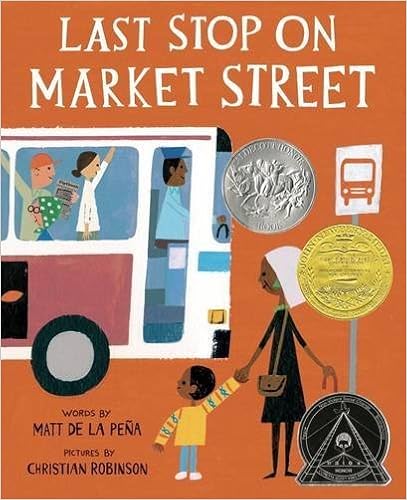
Last Stop on Market Street
Last Stop on Market Street
By Matt de la Pina Illustrated by Christian Robinson
This post and the one to follow were prepared in draft this past spring after visiting my granddaughters in Baton Rouge. A search for quality titles to take to them reaped this one for Lucy (preschool) and the next one for Evie (kindergarten). This grandma and reading teacher always gets behind in publishing, but rest assured these blog posts about quality literature which builds character will continue to spill out for years to come. If you "follow" the blog you will catch the posts!
Wow! Take a look at the awards this recent picture book received! You may be familiar with the best illustrated book of the year that is awarded the Caldecott Medal. This received both a Caldecott Honor award and a Coretta Scott King honor award for its illustrations. Yet, this title ALSO was the winner of the best book written for children, the Newbery. Usually given to novels for ~ grades 3 - 9, this is a stunning achievement for a picture book. School Library Journal recommends it for grades K-2, but Lucy, a preschooler, was touched by the message, and I know that it will resonate with students up through eighth grade and beyond - including adults. Please read and share this book with anyone!
The review from School Library Journal portrays the layers of meaning in the simple plot:
After church on Sundays, CJ and his nana wait for the bus. It's a familiar routine, but this week CJ is feeling dissatisfied. As they travel to their destination, the boy asks a series of questions: "How come we gotta wait for the bus in all this wet?" "Nana, how come we don't got a car?" "How come we always gotta go here after church?" CJ is envious of kids with cars, iPods, and more freedom than he has. With each question, Nana points out something for CJ to appreciate about his life: "Boy, what do we need a car for? We got a bus that breathes fire." These gentle admonishments are phrased as questions or observations rather than direct answers so that CJ is able to take ownership of his feelings. After they exit the bus, CJ wonders why this part of town is so run-down, prompting Nana to reply, "Sometimes when you're surrounded by dirt, CJ, you're a better witness for what's beautiful." The urban setting is truly reflective, showing people with different skin colors, body types, abilities, ages, and classes in a natural and authentic manner. Robinson's flat, blocky illustrations are simple and well composed, seemingly spare but peppered with tiny, interesting details. Ultimately, their destination is a soup kitchen, and CJ is glad to be there. This is an excellent book that highlights less popular topics such as urban life, volunteerism, and thankfulness, with people of color as the main characters. A lovely title.�Anna Haase Krueger, Ramsey County Library, MN
And here is the string of awards:
Winner of the 2016 Newbery Medal
A 2016 Caldecott Honor Book
A 2016 Coretta Scott King Illustrator Honor Book
A New York Times Bestseller
A New York Times Book Review Notable Children�s Book of 2015
An NPR Best Book of 2015
A Kirkus Reviews Best Book of 2015
A Wall Street Journal Best Book of 2015
A 2015 Publishers Weekly Best Book of the Year
A Horn Book Best Book of 2015
BookPage�s �2015�s First Must-Read Picture Book�
The Huffington Post Best Overall Picture Book of 2015
A Boston Globe Best Book of 2015
A Chicago Public Library Best Book of 2015
Chosen for the New York Public Library�s 100 Books for Reading & Sharing List
A Miami Herald Best Children�s Book of 2015
A Raleigh News & Observer Best Children�s Book of 2015
An Atlanta Parent Best Book of 2015
A San Francisco Chronicle Holiday Gift Guide Pick
A Center for the Study of Multicultural Children�s Literature �Best Multicultural Books of 2015� Pick
A Scholastic Instructor 50 Best Summer Book
Chosen for the ALSC 2015 Summer Reading List
A Horn Book Summer 2015 Reading List Pick
Chosen for School Library Journal�s 2015 Top 10 Latin Books List
A Kansas City Star Thanksgiving 2015 Roundup Pick
A Winter 2014-2015 Kids' Indie Next Pick
2015 E.B. White Read Aloud Award Finalist
Nominated for the 2016 Washington Children�s Choice Picture Book Award
Nominated for the 2016 Kentucky Bluegrass Award
By Matt de la Pina Illustrated by Christian Robinson
This post and the one to follow were prepared in draft this past spring after visiting my granddaughters in Baton Rouge. A search for quality titles to take to them reaped this one for Lucy (preschool) and the next one for Evie (kindergarten). This grandma and reading teacher always gets behind in publishing, but rest assured these blog posts about quality literature which builds character will continue to spill out for years to come. If you "follow" the blog you will catch the posts!
Wow! Take a look at the awards this recent picture book received! You may be familiar with the best illustrated book of the year that is awarded the Caldecott Medal. This received both a Caldecott Honor award and a Coretta Scott King honor award for its illustrations. Yet, this title ALSO was the winner of the best book written for children, the Newbery. Usually given to novels for ~ grades 3 - 9, this is a stunning achievement for a picture book. School Library Journal recommends it for grades K-2, but Lucy, a preschooler, was touched by the message, and I know that it will resonate with students up through eighth grade and beyond - including adults. Please read and share this book with anyone!
The review from School Library Journal portrays the layers of meaning in the simple plot:
After church on Sundays, CJ and his nana wait for the bus. It's a familiar routine, but this week CJ is feeling dissatisfied. As they travel to their destination, the boy asks a series of questions: "How come we gotta wait for the bus in all this wet?" "Nana, how come we don't got a car?" "How come we always gotta go here after church?" CJ is envious of kids with cars, iPods, and more freedom than he has. With each question, Nana points out something for CJ to appreciate about his life: "Boy, what do we need a car for? We got a bus that breathes fire." These gentle admonishments are phrased as questions or observations rather than direct answers so that CJ is able to take ownership of his feelings. After they exit the bus, CJ wonders why this part of town is so run-down, prompting Nana to reply, "Sometimes when you're surrounded by dirt, CJ, you're a better witness for what's beautiful." The urban setting is truly reflective, showing people with different skin colors, body types, abilities, ages, and classes in a natural and authentic manner. Robinson's flat, blocky illustrations are simple and well composed, seemingly spare but peppered with tiny, interesting details. Ultimately, their destination is a soup kitchen, and CJ is glad to be there. This is an excellent book that highlights less popular topics such as urban life, volunteerism, and thankfulness, with people of color as the main characters. A lovely title.�Anna Haase Krueger, Ramsey County Library, MN
And here is the string of awards:
Winner of the 2016 Newbery Medal
A 2016 Caldecott Honor Book
A 2016 Coretta Scott King Illustrator Honor Book
A New York Times Bestseller
A New York Times Book Review Notable Children�s Book of 2015
An NPR Best Book of 2015
A Kirkus Reviews Best Book of 2015
A Wall Street Journal Best Book of 2015
A 2015 Publishers Weekly Best Book of the Year
A Horn Book Best Book of 2015
BookPage�s �2015�s First Must-Read Picture Book�
The Huffington Post Best Overall Picture Book of 2015
A Boston Globe Best Book of 2015
A Chicago Public Library Best Book of 2015
Chosen for the New York Public Library�s 100 Books for Reading & Sharing List
A Miami Herald Best Children�s Book of 2015
A Raleigh News & Observer Best Children�s Book of 2015
An Atlanta Parent Best Book of 2015
A San Francisco Chronicle Holiday Gift Guide Pick
A Center for the Study of Multicultural Children�s Literature �Best Multicultural Books of 2015� Pick
A Scholastic Instructor 50 Best Summer Book
Chosen for the ALSC 2015 Summer Reading List
A Horn Book Summer 2015 Reading List Pick
Chosen for School Library Journal�s 2015 Top 10 Latin Books List
A Kansas City Star Thanksgiving 2015 Roundup Pick
A Winter 2014-2015 Kids' Indie Next Pick
2015 E.B. White Read Aloud Award Finalist
Nominated for the 2016 Washington Children�s Choice Picture Book Award
Nominated for the 2016 Kentucky Bluegrass Award
Wednesday, February 12, 2014
Anthologies (3) Primary, Elementary
Anthologies (3) Primary, Elementary
This is the last in a series of three posts in the anthology category of literature that builds character. I will return to this category in the future since there are so many good anthologies. I invite your comments and suggestions for those future reviews in this blog. In the next month I will review anthologies for the upper grade levels.
Ordinary Splendors: Tales of Virtue and Wisdom. Toni Knapp.
Animals from 15 legends and folktales around the world display characteristics of courage, responsibility, honor, and love.
Oxford Book of Children's Stories, The. Jan Mark.
An historical anthology of many of the best children's short stories from the past 250 years, this book offers an array of suitable character building choices.
People Could Fly, The. Virginia Hamilton.
The awards and reviews as presented by the Scholastic website.
This book includes fables such as "The Tortoise and the Hare," a story in which the reader learns that "slow and steady wins the race."
True Valor. Mildred. A. Martin.
Ordinary people perform extraordinary feats of courage during wartime. This book has nine such stories.
Witch of Fourth Street and Other Stories, The. Myron Levoy.
This book contains eight touching stories about various immigrant groups that live on New York's Lower East Side in the 1920's.
Refer back to blog posts for October 4 and October 23 for longer descriptions of two wonderful anthologies not listed in the three "series" posts. The Book of Home and Family and The Book of Virtue.
This is the last in a series of three posts in the anthology category of literature that builds character. I will return to this category in the future since there are so many good anthologies. I invite your comments and suggestions for those future reviews in this blog. In the next month I will review anthologies for the upper grade levels.
Ordinary Splendors: Tales of Virtue and Wisdom. Toni Knapp.
Animals from 15 legends and folktales around the world display characteristics of courage, responsibility, honor, and love.
Oxford Book of Children's Stories, The. Jan Mark.
An historical anthology of many of the best children's short stories from the past 250 years, this book offers an array of suitable character building choices.
People Could Fly, The. Virginia Hamilton.
The awards and reviews as presented by the Scholastic website.
"The well-known author retells 24 black American folk tales in sure storytelling voice: animal tales, supernatural tales, fanciful and cautionary tales, and slave tales of freedom. All are beautifully readable. With the added attraction of 40 wonderfully expressive paintings by the Dillons, this collection should be snapped up."�School Library Journal
A Coretta Scott King Award
A Booklist Children's Editors' Choice
A School Library Journal Best Books of the Year
A Horn Book Fanfare
An ALA Notable Book
An NCTE Teachers' Choice
A The New York Times Best Illustrated Children's Books of the Year
A Booklist Children's Editors' Choice
A School Library Journal Best Books of the Year
A Horn Book Fanfare
An ALA Notable Book
An NCTE Teachers' Choice
A The New York Times Best Illustrated Children's Books of the Year
Scholastic has much to offer on their website for teachers and parents. Here is the link. You can browse their reading lists, teacher resources, and tips for parents. I follow them on twitter and find the tweets useful. I find myself clicking the links to view helpful book lists on current topics such as Thanksgiving or M.L.King Day. http://www.scholastic.com/teachers/book/people-could-fly#cart/cleanup
Tomie de Paola's Favorite Nursery Tales. Aesop, retold by Tomie de Paola.This book includes fables such as "The Tortoise and the Hare," a story in which the reader learns that "slow and steady wins the race."
True Valor. Mildred. A. Martin.
Ordinary people perform extraordinary feats of courage during wartime. This book has nine such stories.
Witch of Fourth Street and Other Stories, The. Myron Levoy.
This book contains eight touching stories about various immigrant groups that live on New York's Lower East Side in the 1920's.
Refer back to blog posts for October 4 and October 23 for longer descriptions of two wonderful anthologies not listed in the three "series" posts. The Book of Home and Family and The Book of Virtue.
Wednesday, October 23, 2013
The Book of Virtue
The Book of Virtue
William Bennett
Up until 1993 when this book came out, I had been gathering stories and poems that teach character with the growing feeling that some day I would have to collect them together into an anthology. I felt duty bound to share these resources so that more parents could read them to their children. Moral education of the young is imperative if they are to grow up to possess a character that knows the good and pursues it. When The Book of Virtue was put into my hands I was relieved of that responsibility. And I was overjoyed. William Bennett had done the job far beyond my poor power. His knowledge is vast and his commentary is inspiring. This anthology of 818 pages is a treasury of great moral stories. As he says in his introduction, moral literacy serves "to show parents, teachers, students, and children what the virtues look like, what they are in practice, how to recognize them and how they work."
Bennett places this apt quotation from Plato's Republic right after his introduction showing how the drive we have to share moral stories with children is a timeless one:
You know that the beginning is the most important part of any work, especially in the case of a young and tender thing; for that is the time at which the character is being formed and the desired impression is more readily taken...Shall we just carelessly allow children to hear any casual tales which may be devised by casual persons, and to receive into their minds ideas for the most part the very opposite of those which we should wish them to have when they are grown up?
We cannot...Anything received into the mind at that age is likely to become indelible and unalterable; and therefore it is most important that the tales which the young first hear should be models of virtuous thoughts...
Then will our youth dwell in a land of health, amid fair sights and sounds, and receive the good in everything; and beauty, the effluence of fair works, shall flow into the eye and ear, like a health-giving breeze from a purer region, and insensibly draw the soul from the earliest years into likeness and sympathy with the beauty of reason.
There can be no nobler training than that.
The book is divided according to ten virtues. Each section provides an array of selections beginning with tales and poems for the very young and proceeding in difficulty with myths, essays, and short stories for older children.
As an example, the first section is entitled "Self-Discipline." It begins with selections for the young such as:
Please by Alicia Aspinwall- a fable about a little word named "please"
A poem Godfrey Gordon Gustavus Gore/No doubt you have heard the name before/Was a boy who never would shut a door! (Seven verses in this light-hearted poem.) by William Brighty Rands
My Own Self - a retellling of an English fairy tale by Joseph Jacobs which teaches that self-discipline is learned through adversity.
The poem To the Little Girl who Wriggles - by Laura Richards
It continues with selections for children a little older:
The King and His Hawk, is a legend about how Ghengis Khan learned to contain his temper. retold by James Baldwin.
Aesop's fables, The Boy and the Nuts and The Goose that Laid the Golden Eggs illustrate how if we do not contain our cravings we may end up wit(h nothing.
The tale, The Fisherman and His Wife (adapted by Clifton Johnson)has a similar moral as does the myth King Midas (retold by Nathaniel Hawthorne).
Selections for older children include:
The Greek myth Phaeton adapted by Thomas Bulfinch.
George Washington's Rules of Civility
Vaulting Ambition, Which O'erleaps Itself - from Macbeth by Shakespeare
How Much Land Does a Man Need? by Leo Tolstoy
Plato, on Self-Discipline from the Gorgias
Aristotle on Self-Discipline from the Nicomachean Ehtics
It is truly an outstanding collection. The rest of the sections are equally rich:
Compassion
Responsibility
Friendship
Work
Courage
Perseverance
Honesty
Loyalty
Faith
A subsequent edition was published which added pictures and contained only the selections for young children from each section. It is called The Children's Book of Virtues.
Tuesday, September 24, 2013
The Three Little Pigs
Our summer vacation is quickly becoming a shimmering memory as we find ourselves already in the fourth week of school. I am still in the trenches as a teacher, my first professional love, but am also spending much of my time consolidating the sources found during the past 30 years at Birchwood School on this topic of literature that builds character. So the blog begins anew with fresh purpose: as a legacy for our alumni, their children, and friends. Sharing stories here is in the spirit of the literary heritage of tales passed down from generation to generation for the instruction of children.
I began this year with my eighth graders telling them the story of The Three Little Pigs. That's right, they are not too old for this nursery tale! They followed me with bemused looks as I told the tale using all the appropriate voices. "Little pig, little pig, let me come in."
"Not by the hair of my chinny-chin-chin."
"Then I'll huff! whooooooooooo! and I'll puff! whooooooooooooooo! and I'll blowwwww your house in!" And down fall in succession the houses of the first two little pigs who had built their houses of straw (first piggy) and sticks (second little piggy). But when the wolf does the same routine with the third little piggy, he fails. Why? Because he built his house out of bricks. It took longer. It was harder work. But he used the right materials and his house stayed put.
The lesson in this fable was easy for these students to see. I was talking about starting the year with the right materials and the right mind set. A second application was that of the carpenter: Imagine him showing up to work without a hammer? without nails? He'd tell his customer, "Sorry, Ma'am, I hope to put your cabinet together today. Shucks, I just forgot my hammer, but I'll see what I can do." What a joke. Eighth graders can see right away the need for sharpened pencils, paper on hand etc. But it requires repeated talks shared by many of us through varieties of stories, biographies, and personal or family anecdotes to infuse children when it comes to having the right motivations and attitudes.
One can't help but wonder how much was behind the original telling of the traditional tales. The origins of these tales are hard to trace, but how they have endured is easier to see. The message is universal, as in the case of this tale about the three pigs: Build your life with solid materials! It may take longer to make, find, and build with bricks but if you take the shortcut and build quickly with straw or sticks your foundation cannot hold you through all manner of wolves and storms that come your way. (Parents and teachers have their own embellishments. The "straw" can be the ideas in your head of what you think you can do without much work. The "sticks" are the ways we do things half-way. etc.) No doubt this tale reflects the instruction and hopes that every parent or teacher has for their child. It also calls to mind the parable of the man who built his house upon the sand or the sower who did not sow upon good soil. Thus, the wisdom of the ages is in the simplest of tales.
When folklorist Joseph Jacobs collected the English tales (as Perrault had done for the French and the Grimm brothers for the German) he had this to say, "This book," he wrote of English Fairy Tales, "is meant to be read aloud, and not merely taken in by the eye." (ed. Maria Tatar. The Annotated Classic Fairy Tales.) Make the drama come alive! (And, with young children there is no need to tack on a lesson. Just tell the tale; lessons seep in over time all on their own.) The origins are hard to trace and the tale spans cultures. An interesting history is assembled in the Wikipedia article. http://en.wikipedia.org/wiki/Three_Little_Pigs
I grew up on the Disney version and the lessons play back as a movie in my mind to this day. But it is my mother's voice that I hear and strive to copy when I squeak to my eighth graders: "Not by the hair of my chinny chin chin!"
Subscribe to:
Posts
(
Atom
)


