Showing posts with label people. Show all posts
Monday, October 26, 2015
Bridging Writers - An Interview with Rich Marcello

Rich Marcello is a poet, musician, and creative writing teacher, and is the author of three critically acclaimed novels. The first, The Color of Home, was published in 2013 by Langdon Street Press, and melds together honest generative dialogue, poetic sensory detail, and �unforgettable characters who seem to know the complete song catalog of Lennon or Cohen.� The second, The Big Wide Calm, was published in 2014, also by Langdon Street Press. The US Review of Books stated, �Marcello�s novel has a lot going for it. Well-written, thought-provoking, and filled with flawed characters, it meets all of the basic requirements of best-of-show in the literary fiction category.� The third, The Beauty of the Fall, will be published in 2016. Faulkner Award Winner Mark Spencer commented, �Few novels are as intelligent and relevant as The Beauty of the Fall. Almost none is as eloquent, compelling, heartbreaking, and ultimately, uplifting.�
You came to writing after a career in high-tech. Can you tell us a little about becoming a working writer? What inspired the transition? And how did you approach learning the craft?
In a way, I�ve always been a writer. I�ve written songs for over thirty years and poetry, as well. When I was in college, I was writing short stories and even had the resident novelist at Notre Dame offer to mentor me. But I was broke and in debt at the time, so I made a decision to go into hi-tech.
About five years ago, after a lot of soul-searching, I realized I�d accomplished what I wanted to in hi-tech and decided to come back to writing. For the first couple of years, I took as many classes as I could to help perfect my craft. I also was fortunate to be mentored by Mark Spencer, who won the Faulkner Award a number of years ago. I�ve probably learned the most about writing a novel through my interactions with him.
You are a musician as well as a novelist. Do the two creative impulses come from the same place? In what ways do composing and playing music compliment your work as a storyteller? How conscious are you of sound on the page?
I do think the creative impulses come from the same place though they manifest themselves in different ways. For me, music is more of short-form medium. Creativity in a song is about the riff, the verse, the chorus, the bridge, the clever lyric. The novel is more of a long-form medium. There, creativity is about the story, the character, the plot turn, and the voice of the POV character or the narrator.
In general, I believe the best fiction is sensual, so I�m aware of sound on the page in addition to all of the other senses. I try to work as many senses as I can into any given scene.
Your second novel, The Big Wide Calm, is a coming of age story about a young musician searching for both the music within and her place in the world. What were some of your formative experiences as an artist, and how did you draw on them in creating your protagonist and her story?
When I was younger, I put out a number of albums and wrote about fifty songs. Mostly, what carried through to TBWC was the process of creating a song. When the protagonist, Paige Plant, writes a song in the book, she uses a process similar to the one I used when I wrote my songs.
Most writers begin as avid readers. Which authors particularly inspire you? Are there writers you consider teachers? Who are you currently reading?
I love to read and am constantly doing so. When I was younger, I was particularly drawn to Gabriel Garcia Marquez, Don Delillo, Milan Kundera, Kurt Vonnegut, Thomas Pynchon, and Walker Percy. I consider all of them teachers. More recently, I�ve loved novels by Lauren Groff, Jonathan Franzen, Alexandra Kleeman, Jessamyn Hope, Elena Ferrante, Jenni Fagan, Jennifer Offill, and Peter Heller.
Could you describe your typical writing day?
I write for five or six hours in the morning. I get up around five and go right to work. I�m one of those writers who believes in the idea of a fictive dream, so in a way I like to go immediately from one kind of dreaming (during sleep) to another (writing fiction in the morning). I also believe that it�s important to write every day, so for the most part, I write seven days a week.
You have two published novels, The Color of Home, and The Big Wide Calm, and a third novel is on the way. How do you compare the experience of writing your third novel with writing your first? Are there things that come more easily? Does your approach change with the material?
In general, things comes easier now. I find that my first draft of any given scene is much closer to the final product than when I started writing years ago. With that said, my third novel, The Beauty of the Fall, is longer than the first two, and it incorporates some dense technology into the narrative, so it has its own challenges. It seems that the more I learn my craft, the more I take on bigger and more difficult topics in my books. That way, each new book is a challenge in its own right.
How do you handle research?
I either travel to the location, or I research on the Internet. For example, my fourth novel, The Latecomers, is set in Sweden and Santa Fe. I�m planning trips to both locations to help me properly place the novel.
You write poetry as well as novels. Do the skills of a poet help in writing prose? How does writing narrative inspire you as a poet?
Writing poetry helps in two ways. First, it helps me write concise sentences that do a lot of work. Second, sometimes I�ll spend an hour on a sentence to make sure it�s poetic enough. I find that placing a poetic sentence here and there in the narrative significantly enhances the reading experience.
Writing narrative inspires me as poet mostly from the perspectives of ideas and stories. I ask myself what idea I want to get across or what story I want to tell in the poem. When I�m done with a piece, I check what I produced against what I intended to produce. I�ve found that using this process hones the emotional content of the poems down to its essence.
You teach fiction workshops and classes. How do you approach teaching creative writing? How does teaching novel or short story writing support your own work?
I like to combine short lectures with workshops on student�s individual pieces. I find that combination works best. The lectures are important because they give the students the necessary tools to create good fiction. The workshops are important because so much of writing is about rewriting a piece to show a more sensual and detailed picture of what happened.
What was the best advice you ever received about writing?
To write the first pass of any scene quickly with the goal of capturing all of the critical emotions, then to rewrite the scene over and over again until you get it right.
Writing is solitary. How do you feed your creative work? What role, if any, does community play in sustaining and nurturing you as an artist?
Yes, it is solitary. I feed my work by connecting with other writers, by teaching, and by spending time with loved ones, including my two Newfoundlands, Ani and Shaman. One of the things I would recommend to every writer is to get a dog or two. They really help with being alone all the time.
Overall, community is very important to me. In fact, the main theme of The Beauty of the Fall is how to create and sustain community in our world. There are many ways to connect in a given community, but I�m mostly trying to connect through the arts these days.
Can you talk a little about any upcoming projects?
I hope to have The Beauty of the Fall out in 2016. I�ve also started work on my fourth novel, The Latecomers. If all goes well, that will be out in 2018.
What encouragement or direction would you give aspiring writers?
First, to learn their craft fully. Many writers I work with have good ideas, but they haven�t put in the time to learn how to write a novel well. Second, to be patient. It takes years to learn how to write a good story. Third, to define success not by financial gain, but by creating a piece of art that makes a difference to at least one other person in the world.
Please join SBWC and Rich Marcello
for a reading and discussion
at our upcoming
Bridging Writers Series
Monday, November 2, 2015,
6:30 - 8:30 p.m.
Thayer Memorial Library, Lancaster, MA.
For more information contact us at 7bridgewriterscollaborative@gmail.com
Sunday, October 25, 2015
What's Your Anti-Drug?
Today I'm excited because I've worked it out with my friend Shelley to give all of the readers who commented on Friday's post {10/23} a copy of her
Mindful Bodies, Mindful Learning packet.

If you left a comment on Friday or Saturday and would like a packet, please email me {bgruener5@gmail.com} and I'll send you the digital file. Thank you, Shelley, for your kindness!
Now, let's be Frank ... how cute is this visual display?
 |
| Isn't it cool how much "chains" and "change" sound alike? |
My friend Terri Brady came to Bales last week to help us kick off Red Ribbon Week with this clever creation. Our plan is to send home red strips of paper so that students and their families can answer the question:
What's Your Anti-Drug?
Then we'll link them together to make a red chain border.
I can't wait to read what their anti-drugs are.
Visits from our PALs start Monday, so I know the halls will be abuzz as those teenage mentors fill our campus with friendship and love.
School family members will get a mustache and a pencil because
We 'mustache' you to be drug-free.
On Tuesday we'll wear our favorite jersey or team shirt to
Team up against drugs.
On Wednesday, our role models from Friendswood High School will lead our Hometown Heroes Pep Rally before school. That's always a fan favorite that supercharges us and sends us soaring because
We've got the power to be drug-free.
On Thursday we'll Give drugs the slip wearing slippers, of course.
And Friday will find us dressing up in 50s garb or our costumes, both of which will say Drug-free is a nifty way to be!
So we've got a busy week ahead as we celebrate Red Ribbon Week
and say yes to healthy choices. Click {here} to download the mini-poster freebies that we'll be putting around campus, like this one from the creative
 |
| Click graphic for source and freebie download at Teachers Pay Teachers. |
Her creations are adorable, so please take a look at her store and support this seller next time you need something. Thank you, Shelly, for generously sharing your time and talent with us!
How will you and your school family celebrate this week?

Saturday, October 24, 2015
The (Almost) Complete Guide to Sorcerers
The (almost) Complete Guide to Sorcerers:
A Minstrel's Take on God's Hot Sister
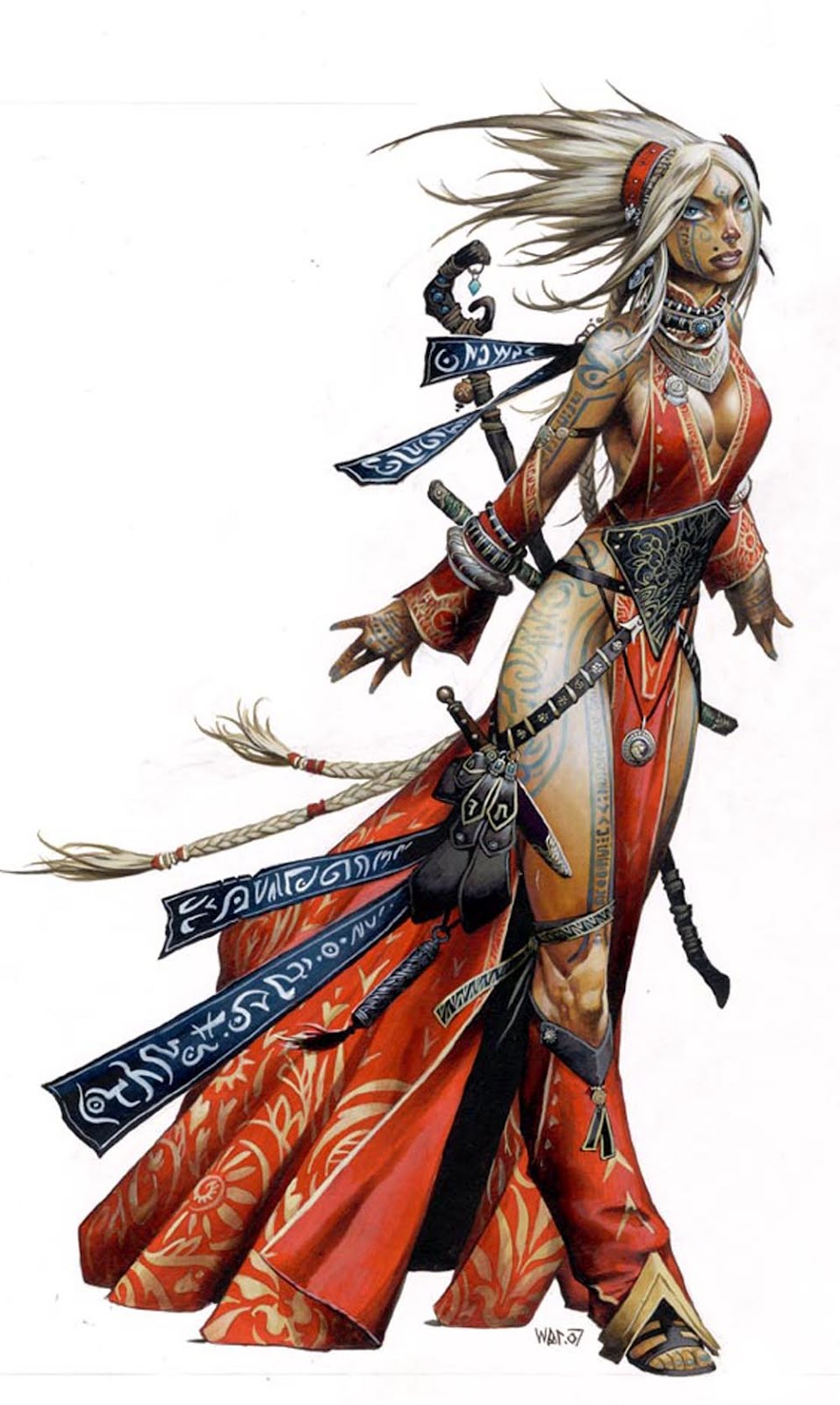
The pure insanity of her outfit proves her magic prowess
Note: Zenith Games did not write this guide. The original guide is in a google doc here and completely unreadable due to edits. If the guide ever gets cleaned up, then I'll move it back there.
Ah yes, we've all heard Treantmonk's yarn on wizards (whose style this may parody at times) and know that, by the numbers, a wizard is more powerful than the sorceress. This is due to the fact a wizard can change is spells chosen- and that he knows so many more spells. But that does not mean that a sorcerer (or a sorceress) is not worth playing- on the contrary the sorcerer class- especially Pathfinder's take on the class- is one of the most powerful classes in the game and gives some fantastic roleplaying opportunities. For the sorceress is magic at it's truest- it's part of here very being. She has not spellbooks to burn and not spellpouch to sunder. Furthermore she's not a bookish sociopath like the wizard- she's the social butterfly, her sheer animal magnetism is rarely matched. She bring style and flair to the arcane, and while there are mechanical differences between the two classes (now more than ever- it's the playing that separates the two. A sorceress does not have to capture magic in a book and slavishly study it- she lives and breathes magic.
Color Coding the Guide:
In this guide I will be Color Coding your various options to provide my opinion on each of these options. Yes its Treantmonk�s system. I�m okay with that
Red: Warning. This is a poor option and should be avoided
Orange: This is an OK option. I'm not recommending it, but it's not bad
Green: I recommend this option. It is a strong choice
Blue: A must have. Your best possible option
Races
Actually most of the races in the Pathfinder make decent sorcerers, but let's start with the...
Dwarf- Gah! No, just move on! If you need to know why than you need to learn the rules!
Elf- They have sorcerer friendly features, but all the races after this one can give a charisma bonus so it's just not as good.
Gnome- Bonus to Charisma (and to con, which you'll need- and a penalty to strength which you won't), bonus to the DC's of the illusion school (one of the better schools to be sure) Low light vision, bonus to perception...oh and a small sorcerer is better than a medium one. I mean it, the only helps- to movement penalty won't effect you when you're flying.
Half-Elf- Plenty of all-around useful abilities and can put that boost toward Charisma (which is important for those just tuning in).
Half-Orc- As with the wizard the half-orc makes an appearance as a viable race for a sorcerer...doesn't that just feel...wrong?. Also of note, a half-orc sorcerer is the most intimidating character there is.
Halfling- Small size and charisma make this a great choice, but it's racial features are simply less useful than the gnomes. My choice for a ray specialist
Human- The extra skill point and the feat will be useful. If you don't put that attribute bonus if charisma I'll beat you with a stick. As always, humans are a top tier race.
You may note that there's really only one bad choice- you'd be right, but for my money, the gnome and the human make the best sorcerers- it seems that, unlike fashion models, there aren't any height requirements (in fact small size is a good thing). Infact, t he other small race, the halfling, is a very close third.
Also sorceresses are good at something other than walking in straight lines.
Stats
Strength- Really the only thing you have to worry about is carrying capacity, this is your main dump stat
Dexterity- Never skimp here, ever. Try to get a 12 or higher. 14 is more comfortable.
Constitution- Same as dexterity, You can trade one for the other (high Dex/ low con or vice-versa) but don't let either go below 12.
Minstrel's note: The need for Con is fortitude saves and HP; the need for Dex is AC, reflex saves and ranged attacks. Con is easier to fake with favored class bonus and the feats toughness and great fortitude- dexterity is the tricky one- so I place Dex over constitution, but don't let either slack for any character ever.
Intelligence- Not that important, but dumping it isn't a good idea, you have more skills than skill points- I'll get to that in the next section.
Wisdom- You can dump this, but I can't suggest going too low- you don't want a penalty to your saves, even your strong one
Charisma- You can get by with a 14, but you never should. If you don't get an 18 get a 20. If you can't get that high (at least an 18) consider re-rolling the stats. This is the end-all be-all for this class
Skills
Just because we have magic, doesn't mean we shouldn't work on our mundane skills. Here's an overview of class skills, the bloodline skills will be reviewed in full in the bloodline section. Spend your points wisely to prove you're more than a pretty face.
Appraise- I like this skill, as I like haggling with shopkeepers, but there should be someone else to do this in the party.
Bluff- If you are the party face this will be important, but being the face isn't as important as some other aspects of the class.
Craft- You may find a use for it, but it can be replaced with spellcraft for making magic items so...nah this is for peasants.
Fly- As you should be flying eventually and this makes you better at it, take if you have the skill points.
Intimidate- The other face skill sorcerers get as a class skill, has fun applications.
Knowledge (arcana)- Fairly important, I mean you should know what you're doing, and it covers a wide range of enemies to find weak spots for, so blue.
Profession- Work? That's for ugly people.
Spellcraft- Your most important skill, not as important for you as it is for wizards, but it can save you the spell identify, can lets you craft magic items- which you'll want to do.
Use Magic Device- Yes! This let you use magic item you normally would get to use- the applications are great. Simply one of the more powerful skills.
Feats
Metamagic Feats:
Metamagic is both more and less useful for sorcerers than wizards. This is due to the casting time restraints and the fact that you don't have to prepare them ahead of time. One thing that is certain is that if the spell is blasty- stay away. There are blasts every level and they scale nicely- so metamagic creates crappy blasts. But there are spells who won't be improved, at least not for several levels (enervation comes to mind) and can make metamagic can be worth it. The fact remains, however, that you can make a wonderful sorcerer without it.
Empower Spell:This is a false economy I fear- I thought it might be applicable to summoning, but Treantmonk pointed out several flaws in that plan- not the least of which is the two round casting time for metamagic summoning. And it's use for blasting isn't really worth it.
Enlarge Spell: It isn't too expensive, and that's nice, how useful it is, well... it's situational
Extend Spell: One of the best out there, double then duration of a spell for one level- this one never wears out it's usefulness.
Heighten Spell: I'm not sure on this one. It really translates to a raise in the save's DC. I see it as good for enchantment as you don't get a replacement for the lowered level versions of charms and dominates for a while, so I'll give it an orange.
Maximize Spell: It's not worth it, not at all.
Quicken Spell: One of the most useful ones on the list, however even quicken isn't a must-have, especially given the existence of metamagic rods.
Silent Spell: The only thing is that if you use this, you probably want still spell as well, but it's a lifesaver that the sorceress can use and the wizard can't (unless the wizard plans on getting bound and gagged...gross)
Still Spell: Again, it's a life preserver- you may never use it, but if the situation comes up, you won't be sorry
Widen Spell: No, most spells don't need a bigger area, and none need to take up a slot that's 3 levels higher to do so.
Item Creation Feats:
Many DM's hate the idea of a magic item shop, so the party relies on treasure to get their needed magic items. To make sure you get what you need, make it yourself (and prove to the world you're more than a pretty face) Treantmonk was pretty on the money so I'll cut and paste his stuff. Special note: if there is a wizard in the party make him do this, he gets these as bonus feats, you don't; furthermore he has access to more spells.
Brew Potion: Potions are bad, overpriced, and restricted for which spells you can apply. Avoid buying potions, and definitely avoid brewing them.
Craft Magic Arms and Armor: The most common magic items to find in the game, however, there could be some definite value to this if someone in your party uses a rare style of weapon, and you can't buy magic items, but for most sorcerers this isn't worthwhile.
Craft Rod: Well you will definitely want rods, however, usually you want the rod to cover a metamagic feat that you DON'T have. I think you should just buy your rods, they're cheap.
Craft Staff: If you are going to item create, this is a good choice. Staves are expensive, and I'm not a big fan because of the cost, but at half price they are better. The important thing is you can cast the spells on the staff with your full caster level, even when you enchant the staff with a lesser caster level. Also there is no limit to the level of spell you can put in the staff.
Craft Wand: Probably worse than craft staff in almost every way. Note: improved familiar owners might want this to let they're familiars use them, while they can craft staffs yet
Craft Wondrous Item: Could be handy for a campaign where you have trouble buying this stuff.
Forge Ring: Very specialized item list, really, I can't see this being worth a feat.
Scribe Scroll: I have to change this one- sorcerers can't use this one to the same effect as the wizard, they won't need it.
Other Feats you may want to consider:
Hah! now that we're talking- metamagic and item creation is always dependent on the kind of game you're playing, and are in fact skip-able, here is a guide of feat you actually might want to take.
Agile Maneuvers: I can't suggest this one- but it may get you out of a bind here and there
Arcane Armor Training: NO! stay away, even eldritch knights have better uses of swift actions!
Augment Summoning: I'm going to suggest this to any would-be summoner, it's practically blue. the only issue is taking the nigh useless spell focus: conjuration.
Arcane Strike: This is for bards, Eldrich Knights will like it, but will eventually grow out of it with that Spell Critical ability, you don't need this.
Combat Casting: You shouldn't need this- but eventually your meat shield will screw up, they all do. And casting defensively is much harder now.
Defensive Combat Training: Use your HD instead of your BAB when determining your CMD. Yes.
Eschew materials: you get it for free. yay!
Improved Counterspell: Counterspelling is a waste of your turn, instead of stopping an enemy from casting (and yourself) just kill him. End of story.
Improved Familiar: Mephit+use magic device= two sorcerers for the cost of one
Improved Initiative: Get this. The sooner you go, the sooner your team wins.
Nimble Moves: this can save you in times of peril- if you can fit it, you won't be choosing wrong.
Spell Focus: Increases the DC by 1 for one school. I hate when the enemy makes their save. Some schools however won't ever need this. special not that the otherwise unhelpful spell focus: conjuration leads to the wondrous augment summoning
Greater Spell Focus: Not as helpful as the first one, but not a waste of a feat- you could probably do better is all
Spell Penetration: I like this one, its as good for sorcerers as it is for nerdy wizards
Greater Spell Penetration: Not a bad choice, but not as helpful as the first +2
Toughness: You'll never have enough hit points.
Bloodlines
Here are the bloodlines (probably why you are here) my comments are in violet. As for the spell ratings: mostly based on Treantmonk's ratings, tweaked here and there based on my opinions. I'm not giving an overall review for a bloodline, just taking their powers one at a time, as some terrible bloodlines get some great powers and vice-versa
Aberrant
Class Skill: Knowledge (dungeoneering). Knowledges are always helpful- though this isn't a top-tier one
Bonus Spells: enlarge person, see invisibility, tongues, black tentacles, feeblemind, veil, plane shift, mind blank, shapechange.
Overall, not too bad, there's some stinkers here, but there are some good ones too.
Bonus Feats: Combat Casting, Improved Disarm, Improved Grapple, Improved Initiative, Improved Unarmed Strike, Iron Will, Silent Spell, Skill Focus (Knowledge [dungeoneering]).
There are enough good feats here to more than make up for the bad. Now if you could only get yourself to wait until level seven to take Improved Initiative...
Bloodline Arcana: Increasing the duration for a good set of buff spells is a great thing indeed.dwarf druid
Bloodline Powers:
Acidic Ray: Of any of the at-will abilities, the rays are the ones that will see the most use.
Long Limbs: I may have to re rate this ability, as there aren't a whole lot of great touch spells, but it does make the existing ones much, much better.
Unusual Anatomy: Nice perk.
Alien Resistance: As written, spell resistance is a two-edged sword. You become partially immune to magic-all magic. You can lower it as a standard action. Ouch- hope the cleric has spell penetration if things go sour (he probably won't).
Aberrant Form This is a really decent list of perks, I really like the blindsense.
Abyssal
Class Skill: Knowledge (planes). A good knowledge knowledge skill, but the arcane bloodline's option is flat-out better
Bonus Spells: cause fear, bull's strength, rage, stoneskin, dismissal, transformation, greater teleport, unholy aura, summon monster IX.
The abyssal sorcerer really takes a hit here, most of these spells are no good at all. Unholy aura is a cleric spell, and a fairly good one if you fight good things regularly, but I'm assuming you don't.
Bonus Feats: Augment Summoning, Cleave, Empower Spell, Great Fortitude, Improved Bull Rush, Improved Sunder, Power Attack, Skill Focus (Knowledge [planes]).
Not the best list by far, be sure to take Spell Focus: Conjuration so you can take Augmented Summoning, after that take your preference of non fighting feats, unless you are a Gish, in which case- see the prestige class section.
Bloodline Arcana: Most summons have a decent amount of DR anyway, and in roughly the same proportion- it does buff up lower-level summons at higher levels. But there is one good trick to this, you can give your celestials DR/good and in most campaigns you won't be fighting too many people who possess good weapons. When you get added summonings it's power fades- but it will help until you get there.
Bloodline Powers:
Claws: Spell casters don't need extra m�l�e attacks- especially ones that can't even be used at will.
Demon Resistances: These will probably come up, sooner or later, not a bad ability at all.
Strength of the Abyss: This in no way adds to a straight sorcerer build, but it's nice to have. Now you can carry all your stuff. Like a pack mule.
Added Summonings: This makes the entire bloodline worth it.
Demonic Might: Not bad, but there are better ones out there.
Arcane
Bonus Spells: identify, invisibility, dispel magic, dimension door, overland flight, true seeing, greater teleport, power word stun, wish.
Consistently solid- iconic too. One of the better bonus spell lists to be sure. Dispel magic might be better than I'm giving it credit for, I haven't gotten a chance to use the Pathfinder version yet.
Bonus Feats: Combat Casting, Improved Counterspell, Improved Initiative, Iron Will, Scribe Scroll, Skill Focus (Knowledge [arcana]), Spell Focus, Still Spell.
While not all these feats are great, all of them are "mage" feats, all of them are relevant- making this bloodline somewhat unique. I'd go for Spell Focus, Improved Initiative and Combat Casting, unless you learn them too early- oddly enough, it doesn't specify if you can take spell focus more than once for bonus feats (taking a new school every time) I'd say yes myself.
Bloodline Arcana: This gives a bonus to the DC's of spells effected by metamagic, which is quite nice.
Bloodline Powers:
Arcane Bond: Arcane bond is both better and worse for sorcerers than it is for wizards.On one hand it creates a weakness the sorcerer doesn't normally have- a pet to die and a staff to break. I really advise against a bonded item- it's primary benefit is of little use to sorcerers- and extra slot that's spontaneously chosen- not need, you have plenty of spontaneous slots. The familiar- while fragile benefits from your UMD score (you did take plenty of ranks in UMD right?) a ran, or more reliably a Mephit can do wonders.
Metamagic Adept: This, along with th is bloodline's capstone, makes the Arcane Bloodline sorcerer the best metamagic user- not that metamagic is the end-all- be-all, but if you want to use it, this is the best option.
New Arcana: Extra spells known are the most important thing you could give a sorcerer.
School Power: Free Spell Focus- that's stackable, you could stack it with spell focus and greater spell focus to get a +4 to spell DC of a school, good for charm or dominate spells- and there are better options.
Arcane Apotheosis: Solid, not sure how useful it is at level twenty- this might warrant an Orange rating- but it's defiantly solid
Celestial
Class Skill: Heal. Does anyone use this skill?
Bonus Spells: bless, resist energy, magic circle against evil, remove curse, flame strike, greater dispel magic, banishment, sunburst, gate.
Not terrible spells, but not fun ones at all. Bless, flame strike and sunburst are all cleric/druid spells, none are particularly great, flame strike is better than cone of cold in my opinion but not enough to warrant a higher rating. I like gate myself- but the nerf hit it hard.
Bonus Feats: Dodge, Extend Spell, Iron Will, Mobility, Mounted Combat, Ride-By Attack, Skill Focus (Knowledge [religion]), Weapon Finesse.
While the celestial sorcerer's spells were lackluster and somewhat helpful- the Celestial sorcerer's feat selection are lackluster and bad - I gave kind reviews for mounted combat and weapon finesse as they are useful for some applications (mount and touch spells specifically) though beyond those applications, they're kind of useless. You can get skill focus: knowledge religion, a non-class skill. Weird.
Bloodline Arcana: More or less the same as the Abyssal Bloodline Arcana but worse, you'll fight plenty of enemies that can cut through this like butter.
Bloodline Powers:
Heavenly Fire: Not very damaging, but the healing is interesting.
Celestial Resistances: Not game breaking, but good to have
Wings of Heaven: I know I'm overrating this- but I love flight, and it's one less spell to learn, although by level nine you might have already taken fly...
Conviction: At this time you really should expect something better, Luck domain clerics get so much better.
Ascension: Some cool features, (endless flight!) but not groundbreaking.
Destined
Class Skill: Knowledge (history). Not the best knowledge in the book- not even used to find a monster's defenses
Bonus Spells: alarm, blur, protection from energy, freedom of movement, break enchantment, mislead, spell turning, moment of prescience, foresight.
This isn't the best list of bonus spells- in fact it's worse than it looks as most of these are fairly situational. The best spell on here is freedom of movement- which isn't a wizard spell, so that's a plus
Bonus Feats: Arcane Strike, Diehard, Endurance, Leadership(too good), Lightning Reflexes, Maximize Spell, Skill Focus (Knowledge [history]), Weapon Focus.
Wow, just wow.
Bloodline Arcana: Not terrible, when you take into account what other abilities the Destined sorcerer gets, but this is an awfully strict number of spells.
Bloodline Powers:
Touch of Destiny: Not useless, but the fighters should be in the thick of it, and you shouldn't.
Fated: It will be helpful, especially if you lose initiative.
It Was Meant To Be: More limited than the Conviction ability of the celestial sorcerer- but you can use it more and you get it earlier, it evens out.
Within Reach: Quite nice, not something to build off of though.
Destiny Realized: Much more limited than the other capstones, and it should be noted that critical hits shouldn't be the focus of a sorcerer. Fun fact: other bloodlines give immunity to critical hits. So there.
Draconic
Bonus Spells: mage armor, resist energy , fly, fear, spell resistance, form of the dragon I, form of the dragon II, form of the dragon III, wish.
Well, this appears to be the best spell list so far, but there is a problem. See how three of them are form of dragon? That's a major hit. A third of the sorcerer's bonus spell accomplish what is essentially the same thing- and it not like you can trade those out. On the other hand Destined sorcerers get four spells that are never good-the lower forms of dragon are good for a while. also spell resistance is a cleric spell, it's not bad- if you like spell resistance.
Bonus Feats: Blind-Fight, Great Fortitude, Improved Initiative, Power Attack, Quicken Spell, Skill Focus (Fly), Skill Focus (Knowledge [arcana]), Toughness.
Three of these feats are must-have (you should know which ones by now). If you take them for normal feats, take yellow ones.
Bloodline Arcana: Not only is this blasty, but it's single energy blasty, yuck.
Bloodline Powers:
Note: you get to choose a specific type of dragon for this class, determining the energy type of several features, and the shape of the breath attack, the difference of which varies little. For the record, I believe fire is the riskiest as the most enemies are resistant to it, but also the most weak to it (from a cursory look through the bestiary).
Claws: Pretty much the same as the demon's claws.
Dragon Resistances: Similar to abilities found in the celestial and abyssal bloodlines- I like it better, for the AC boost, but it's still in the same league.
Breath Weapon: Not a bad feature, as it scales quite nicely- While it's only an element blast, consider this, after you get this scaling blast, you won't need to take any more. And 1 to 3 uses of the ability should be enough, as you don't want to spend all your time blasting
Wings: You get this fairly late, but it's at will- free up a spell at this point (assuming you aren't expected to cast fly on the other, less talented party members).
Power of Wyrms: Similar boosts to several that have been seen before, rather good all around.
Elemental
Class Skill: Knowledge (planes). A good knowledge knowledge skill, but the arcane bloodline's option is flat-out better
Bonus Spells: burning hands, scorching ray, protection from energy, elemental body I, elemental body II, elemental body III, elemental body IV, summon monster VIII, elemental swarm.
Not a good list, but there are two points of interest. First: if you rule that you can cast while in elemental form, those spells improve a notch. Second- I'm not sure just how good the elemental swarm is, it has an out of battle casting time (ten minutes!) but you summon quite an army with it, and durable ones at that- each elemental gets max HP per HD- not bad. It is a druid spell, if that means anything either way to you.
Bonus Feats: Dodge, Empower Spell, Great Fortitude, Improved Initiative, Lightning Reflexes, Power Attack, Skill Focus (Knowledge [planes]), Weapon Finesse.
Not a good list of feats, to be sure.
Bloodline Arcana: Really? That's purely flavor-based, not worth it.
Bloodline Powers:
Note you get to choose an element to base your bloodline on. The elements themselves differ little in power- but the movement forms differ quite a bit. My reviews of the movement s will be rated in the elemental movement section-as is proper
Elemental Ray: Rays are more helpful than touch attacks (or claws)- but keep in mind there are more useful ones out there.
Elemental Resistance: Not as useful as other abilities of this sorts as the defenses it gives are more specific than others but more potent- a bad trade.
Elemental Blast: Similar to the Draconic breath attack, but somewhat better, due to range.
Elemental Movement: The usefulness of this ability varies with element- the flying of the air elemental is the best, and the swimming of the water one is the worst. The score I gave is an average- I rate them one by one thusly: air, earth, fire water.
Elemental Body: Very similar to other capstones, I do like immunity to critical hits and sneak attacks, especially.
Fey
Bonus Spells: entangle, hideous laughter, deep slumber, poison, tree stride, mislead, phase door, irresistible dance, shapechange.
This isn't a bad list at all, though some of the spells are rather lackluster. Entangle, Poison and tree stride are all druid spells, which is neat- oh and entangle is a rather good spell indeed.
Bonus Feats: Dodge, Improved Initiative, Lightning Reflexes, Mobility, Point Blank Shot, Precise Shot, Quicken Spell, Skill Focus (Knowledge [nature]).
I'm not 100% on my ratings of precise and point blank shot- they're dead useful for a ray mage, which isn't a bad bit of spells.
Bloodline Arcana: This is a group of spells that needs every boost it can get- if you use the dominate line, you won't be sorry you have this.
Bloodline Powers:
Laughing Touch: It's not a bad ability, but it's still touch range, so it's a last resort ability at best.
Woodland Stride: This situation comes up fairly often in the campaigns I've been a part of- and the ability to take a 5 foot step in the woods is fairly nice. But there's no denying that it's situational.
Fleeting Glance: This is helpful- saves you spells cast and is measured in rounds, keeping you from wasting a power, used for in-combat situations, not out of combat ones.
Fey Magic: You can use this ability at will, meaning you'll use it every time you think you've failed against spell resistance. That makes it more useful than other luck-based abilities. I mean, you'll probably never have to worry about spell resistance again.
Soul of the Fey: Animals don't attack you- pretty nice, and that's just the start. However- Cold Iron DR is cut through fairly easily at level 20 at this point, all it takes is a +3 weapon. Still, DR 10 is handy, even if it only works against weaker enemies- makes you immune to bugbites.
Infernal
Class Skill: Diplomacy. You might consider taking this skill regardless if it was a class skill, it's really good.
Bonus Spells: protection from good, scorching ray, suggestion, charm monster, dominate person, planar binding (devils and creatures with the fiendish template only), greater teleport, power word stun, meteor swarm.
This list isn't so hot, first off, notice the blasts- scorching ray and meteor swarm- they're not the kind of spell's I'd take on my own. Second- power word stun require metagaming to use properly and planer binding, while quite good, isn't something you need every day. I should note that the Protection from alignment spell is quite good, but most players shouldn't need protection from evil all to often.
Bonus Feats: Blind-Fight, Combat Expertise, Deceitful, Extend Spell, Improved Disarm, Iron Will, Skill Focus (Knowledge [planes]), Spell Penetration.
There's so bad choices to be sure, though it does have enough good ones to get by. There are two things I'm not sure of my ratings for though- combat expertise- what use is this to a sorcerer really? I suppose you can take an attack penalty on rays and touch spells do raise your defense, but is that really worth it? Second- the value of skill boosting feats- I've been valuing skill focus fairly well, as a +6 to a skill is nothing to sneeze at, but I remain unconvinced on the feats like Deceitful. Am I wrong? Are the skill focus worse than I think or the +4/+4 feats better? Or did I get it right the first time?
Bloodline Arcana: Roughly equal to the Fey Bloodline Arcana.
Bloodline Powers:
Corrupting Touch: The three touch abilities (laughing, corrupting, and grave) seem fairly balanced- the laughing touch is more potent, but only has one round duration. But I'm not sure if the "evil aura" ability is as good as the grave touch's stackablility- to go with my gut, I'd say it's worse, but not terribly so.
Infernal Resistances: I'd rate this roughly equal to the other resistance abilities.
Hellfire: Smaller area than the elemental burst, but it adds a status ailment. I'd rate it better if the status ailment effected nongood targets.
On Dark Wings: The same as Draconic wings.
Power of the Pit: This gives several resistances and a couple immunities- the darkvison is nice, but it doesn't make or break it.
Undead
Bonus Spells: chill touch, false life, vampiric touch, animate dead, waves of fatigue, undeath to death, finger of death, horrid wilting, energy drain.
Wow, you go through a list of fairly bad spells, to get two rather decent ones- it's not that there aren't any good necromancy spells, it's just that none of them are Undead bloodline spells.
Bonus Feats: Combat Casting, Diehard, Endurance, Iron Will, Skill Focus (Knowledge [religion]), Spell Focus, Still Spell, Toughness.
Definitely enough feats to get you by. Why did I rate skill focus: knowledge religion higher for the Undead sorcerer than for the celestial one? Two reasons: first- it's now a class skill. Second- if your playing an Undead sorcerer your planing on fighting with or against Undead- you'll need it more.
Bloodline Arcana: This open some avenues that no one else gets- you can cast enlarge person on your skeletons- or charm person on the enemies zombies.
Bloodline Powers:
Grave Touch: Better than corrupting touch, but it's still a touch ability.
Death's Gift: The usefulness of the DR versus nonlethal damage is kind of dubious, but the boost to cold damage makes this power somewhat helpful.
Grasp of the Dead: Better than the other blasts due to the immobilization effect, very nice
Incorporeal Form: This is a good ability- incorporeal form can save your life.
One of Us: This gives a lot of boosts, some better than others. I find it comparable to the fey bloodline capstone.
Bloodline Overview
Now, in reviewing the bloodlines, I've learned quite a few things I didn't know going in, etcthe Celestial bloodline's a bit better then I gave it credit for and the elementa one is worse than I thought. Another example: all bloodlines have some bad spells. I don't mean downright rotten spells, I mean ones that aren't good for sorcerers and you wouldn't normally take-like remove curse. It's not a bad spell, but you won't cast it every day. Now, I didn't include this in the review- I rated each spell in a vacuum (for the most part). To for a rough guideline figure that any orange or red spells are ones you wouldn't normally take as a sorcerer (not just my ratings but also Treantmonk's ratings in the wizard guide), this rule isn't hard and fast, but it's a good rule of thumb. That said, there also seems to be at least one terrible spell in each bloodline- not everyone, but each bloodline will give you a spell you probably won't use.
Another thing I've learned is that since you only get three bonus feats, the designers made sure to give you three usable feat choices, and more or less, made the rest thematically appropriate but bad choices mechanically for a sorcerer- even then the best choices for some bloodlines are feats you wouldn't normally take (skill focus comes to mind...). On the other hand a lot of bloodline include feats that are good, but are usually take before level 7- like toughness and combat casting. This isn't helped by the fact that there aren't many good spells for sorcerers in the Pathfinder RPG book. If you have accept to 3.5 material in your campaign, this is a very different case- but I don't want to get into that here.
Taking all this into account- which bloodlines should you choose- what criteria is most important? Flavor comes to mind- this is a optimization guide but never ignore a good character concept, don't forget this.
Beyond that, the spells are important-spells are the most important class feature a sorcerer has. The three best bloodlines based on spells (in my opinion) are thus: Arcane (as all of these spells are familiar, and most are useful- thee only really bad one is power word stun); Fey (not all of these are eye openers but not are particularly bad, entangle is a catch) and Draconic (yes there are some redundant ones here but all three form of dragon spells are good before they become obsolete and the rest of the spells are good). The three worst (again, my opinion) are these: Elemental (just awful, it has all four elemental body spells, none of which are good, if you are allowed to cast as an elemental it's better, but it's still not a good list.); Abyssal (This has spells that aren't just bad, they are debuffs pretending to be buffs- even a Gish doesn't want transformation) and Undead ( they seemed to want to collect all the bad necromancy spells in one place, furthermore it's focus on touch spells- not a group to be specialized in without the aberrant bloodline to be sure...and you can't). Two notable bloodline spell lists are the Celestial and the Destined, both have a group of spells that, taken individually, aren't bad, but don't add up to a good build. In this the Destined is among the worst (it's a runner up) and the celestial is the essence of... meh.
After spells other class features take a back seat. Some are quite good (or bad), butusually they aren't enough to make or break a build. There are exceptions though. Most obviously is the abyssal bloodline. over all it's not a good blood line, but it has a remarkable saving grace- Added Summonings. This may be the strongest feature of any one the bloodlines- it's good enough to lose a caster level. How do I know? There's a prestige class in 3.5 that does just that- and it's to totally worth it. It's called the Malconvoker, and it's from The Complete Scoundrel (a vastly underrated book). Treantmonk wrote a guide for it. Does this make the Abyssal bloodline the best choice? No, as you don't get the ability until level 15, and many characters never see that level. And there are other bloodlines that give you cool and useful features sooner- like Long Limbs, or New Arcana.
If, after reading all this, you still don't have a bloodline in mind- take the Arcane Bloodline. It may be the most powerful, and is the closest in flavor to the 3.5 sorcerer. I don't mean that all sorcerers should take the arcane bloodline- but it is very powerful- and generic.
Note: Zenith Games did not write this guide. The original guide is in a google doc here and completely unreadable due to edits. If the guide ever gets cleaned up, then I'll move it back there.
Subscribe to:
Posts
(
Atom
)


