Showing posts with label #cyberPD. Show all posts
Saturday, July 23, 2016
Meeting Students Where They Are: DIY Literacy Ch 5-6 #cyberPD

In both my time in the classroom in large learning communities and then in supporting readers reading intervention, I continually worked to differentiate for learners. No two learners are ever the same, and as Kate and Maggie remind us this can be challenging to balance in classrooms. Using tools like charts, demonstration notebooks, micro-progressions, and bookmarks help to not only make learning more concrete for students but also allow for greater differentiation and personalization. These tools help to develop "a sustainable practice that meets kids' needs (p. 72). Working to meet the variety of needs in a classroom takes thoughtful practice. The authors help us to see how tools can not only support students who need help, but they can also extend learning for students who need more push.
These chapters reminded us to:
- Look for signs tools are working: use, struggle, shifts, growth, engagement
- Look for signs tools can be removed: automaticity, awareness
- Build effective tools: co-create; use popular culture, metaphor, kid language, space, color, branding
- Be intentional about location
I created this visual representation of key points from the reading.

In Closing
I can't thank the #cyberPD community enough for all they have shared during this event. I'll be weeks browsing through the posts and will return throughout the year for the many ideas that have been shared.
Thanks again to this amazing cast of #cyberpd! You are inspiring! Don't forget our final chat! Next Wednesday NIGHT! pic.twitter.com/aw0bSVMHlP� Michelle Nero (@litlearningzone) July 21, 2016
My Past Posts
Becoming Strategic Chapters 3-4
DIY Literacy Tools Chapters 1-2
Friday, July 15, 2016
Becoming Strategic: DIY Literacy #cyberPD Ch 3-4
Becoming Strategic and Developing Automaticity
In chapters 3-4 there is much talk about remembering and rigor. I often find when students "don't remember" something it is more likely they don't have the strategies to work through what I'm asking them to do. When students don't appear to be working at the edge of their learning, I often find I need to help show them what is next. Both remembering and vigorous work come from understanding, strategic action, and authentic learning opportunities.
These two chapters show us how to use micro progressions (as well as charts, demonstration notebooks and bookmarks) to make teaching more explicit and help students discover the next steps in their learning. Katie and Maggie remind us (p. 62), "We encounter trouble when we teach too much to hold onto, too much to remember." They share the way tools can help students prioritize, choose essential skills, and be accountable for new learning. As we read we are reminded that adjusting our language, working together, differentiating instruction, making goals explicit, and providing authentic learning opportunities can help students work toward independence. Through these opportunities we can say to students, I "hope that you will fold some of [these] lessons into your reading forever, that some of these strategies will become a part of you (p. 58)." It's the side by side time with our community, in daily conferring, in small groups, that help us to listen and adjust our teaching.
DIY Literacy
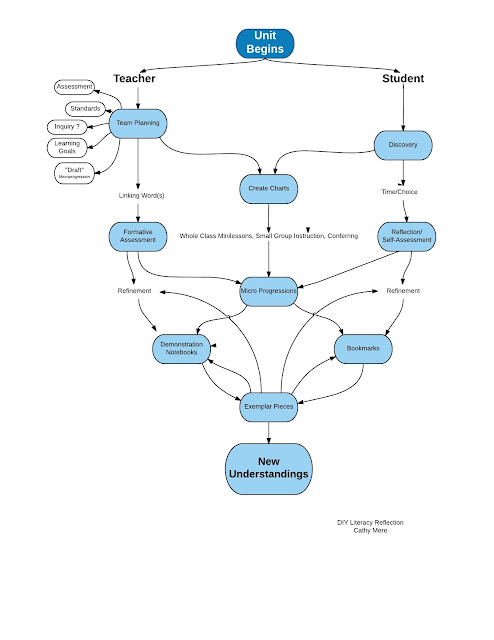
I've been trying to think through how this might look for our students in communities of inquiry. I used Lucid Charts to try to show the way tools might fit into a cycle of learning. (It's a work in progress, but I think it begins to show the way tools might fit into a unit of study and support student learning.)
This post is part of the #cyberPD book talk taking place this July. Stop by the community to read more reflections of participants.
Saturday, July 9, 2016
#cyberPD
About the Authors
BE YOURSELF
DIY Literacy
Explain Everything
Flowvella
Kate and Maggie Roberts
Katie Wood Ray
Wondrous Words
writer's workshop
DIY Literacy: #cyberPD Reflection Ch 1-2 +Bonus

My Response
My response includes a few key points from the chapter and an attempt to work through the tools in thinking about supporting students in the study of structures for writing.
Like many participants I wanted to try some new digital tools during this virtual chat. For this response, I chose Flowvella and then put the presentation into Explain Everything. On a side note, I attempt to work through the charts/notebook/progression/bookmarks. I would likely have charts/notebooks/progressions as digital and thought the chart and notebook page would help a student select a strategy which would then be written on a post-it for the student to try.
More About July's #cyberPD Event
Participants post weekly reflections in the Google Community.
Our Book Talk Schedule:
- Week of July 3rd: Ch 1&2 Bonus
- Week of July 10th: Ch 3&4 Week of
- July 17th: Ch 5&6
Our Twitter Chat Schedule
- Thursday, July 7th at 10 AM EST: Ch 1&2 Bonus
- Thursday, July 14 at 10 AM EST: Ch 3&4
- Thursday, July 21 at 10 AM EST: Ch 5&6
- Final chat week of July 24th (time and date TBA)
Sunday, July 3, 2016
The Basics of #cyberPD
I've had my book, DIY Literacy by Kate and Maggie Roberts, on reserve waiting for July's #cyberPD event. If you are joining us here are a few things you might want to know.
1. Follow the conversation on Twitter using the hashtag #cyberPD.
2. Join the #cyberPD Google Community.
3. Introduce yourself in the Google Community.
4. Read the introductions. You might find people you'd especially like to connect with in this event.
5. Read each week's chapters.
Thanks to @rbharder & @PicStitchApp for sharing the #cyberPD #DIYLiteracy image! ?? the learning community we share! pic.twitter.com/5hcS9IWmwJ� Michelle Nero (@litlearningzone) June 30, 2016
6. Post your reflection before the end of the week in the Google Community (post directly on Google, add a link to your blog reflection, or link other digital reflections, anything goes).
7. We suggest that you comment on at least three posts in each week's conversation. It's the strong digital citizenship of this group that makes this a great experience year after year.
8. Make the event what you need it to be for your learning.
You might want also want to know:
- You can join our collaborative Pinterest Board
- You can join our weekly Twitter chats each Thursday morning at 9 a.m. CST/10 a.m. EST.
- There will be a final Twitter chat. (date & time to be announced later)
If you have any questions, Michelle Nero (@litlearningzone), Laura Komos (@LauraKomos), and I (@cathymere) are happy to help.
Welcome to the past participants who have helped to make this event one of the most amazing summer professional development experiences....and a big hello to all of the new people joining us this year. We're so happy to have you.
Looking forward to the conversation.....
Saturday, June 4, 2016
#cyberPD
#cyberPD16
DIY Literacy
Franki Sibberson
Kate and Maggie Roberts
Laura Komos
love
Michelle Nero
The 2016 #cyberPD Book Is....
It took some time for Laura Komos, Michelle Nero and I to select the title for this year's #cyberPD virtual book talk. We spent much time pouring over book stacks in the #cyberPD Google Community. We went back and forth for days on Voxer. There were times I wasn't sure we were going to be able to narrow to one title. As many of you have discovered, there are many new great books for professional reading that have recently been released (my stack for this summer is here). #goodproblems
It's never easy to choose a book for the event. We always try to select a book which will reach a wide range of educators, sustain thoughtful conversation, and help us grow in the work we do with children. So, you're wondering, what's the title?
Clues
#1: The book was in a lot of stacks posted in the Google Community.
#2: I lost a bet with Mandy Robek (I'll be buying her ice-cream...she'll be buying a book):
@litlearningzone This is a tease! #cyberpd Wondering if it's in my stack, I never published. @CathyMere often reads my mind @LauraKomos� Mandy Robek (@mandyrobek) June 3, 2016
@CathyMere free ice cream but I'm not sure this is fair tough to focus my TBR #cyberpd
Nope --- it's not in Mandy's stack.� Mandy Robek (@mandyrobek) June 4, 2016
#3: The person who wrote the forward for the book was one of our authors last year and is the new NCTE Vice President (Yay!!!!).
#4: The book has a popular video series.
Yep, you've probably guessed it by now. This year's #cyberPD title will be DIY Literacy by Kate and Maggie Roberts. We think this book will speak to educators across grade levels and subject expertise. We think it will support our summer community learning conversations...and we hope it will help us to envision possibilities for improving the work we do with children in the upcoming school year.

So....we're hoping you'll join us for July's 6th Annual #cyberPD Event. The #cyberPD community is now nearly 200 strong. The conversation will take place across July. Each week participants will read the featured chapters, share a reflection in the Google Community (reflect directly in the community, link personal blogs, or share other creations that demonstrate understanding...we're flexible), and finally comment on other community members' reflections.
Week of July 3rd: Chapters 1-2 & Bonus
Week of July 10th: Chapters 3-4
Week of July 17th: Chapters 5-6
Week of July 24th: Final Twitter Chat
**Last year we added a weekly Twitter chat for participants. This was a popular addition for many of our participants so we will continue to host a weekly chat for participants who prefer a little real-time conversation. Stay tuned.
We're hoping you'll join us for our global professional book talk. It's sure to be fun!
Links You Might Find Helpful
- #cyberPD Home
- #cyberPD Community (join here)
- Growing Professional Learning Conversations with #cyberPD
Sunday, May 15, 2016
#cyberPD
#cyberPD stacks
#cyberPD16
#digilitSunday
#k6diglit
Laura Komos
love
Michelle Nero
professional_learning
professional_reading
DigiLit Sunday: Refresh -- What's in Your Professional Book Stack? (6th Annual #cyberPD)
#cyberPD
As the school year begins to wind down, I'm beginning to feel the excitement of having a little extra time for summer learning. One of my favorite ways to refresh in the summer is to join professional conversations around literacy --- and, of course, one of my favorites is #cyberPD. This year will be the 6th annual #cyberPD conversation. Each year, Laura Komos, Michelle Nero, and I collaboratively host a virtual professional reading conversation across blogs. The community has grown over the years and is now nearly 200 members strong.
Each year one professional book is chosen to be read by the #cyberPD community. During the month of July, the book is discussed across three weeks. Each week participants read and discuss a different section of the selected book. Past titles have included (revisit conversations here):
- 2011 Conferring: The Cornerstone of Reader's Workshop by Patrick Allen
- 2012 Opening Minds by Peter Johnston
- 2013 Who Owns the Learning by Alan November
- 2014 Reading in the Wild by Donalyn Miller
- 2015 Digital Reading: What's Essential by Franki Sibberson and Bill Bass
- 2016 To Be Determined
Share Your Stack

As usual, my stack is way too big. There are just so many books to be read...


Join Us
What's in your stack? I hope you'll share your professional reading plans with our community and join us in July for the conversation.
Anytime: Join #cyberPD Google Community
By May 31st: Share your book stack
June 4th: #cyberPD book announced
July: #cyberPD conversation (3 weeks, with one reflection each week)
 As part of a continuous collaboration among educators interested in digital learning, Margaret Simon hosts a weekly Digital Learning round-up on her blog: DigiLit Sunday. Stop by Reflections on the Teche.
 Sunday, September 20, 2015
#cyberPD
#digilitSunday
DigiLit
DigiLit Sunday
digital literacy
Lori Green
Margaret Simon
people
Randall Sampson
Sway
DigiLit Sunday: Playing Along with Sway (Why Digital Literacy?)
This morning I woke up trying to decide what I would post for #DigiLitSunday. As I was working my way around the internet, I received a tweet from Margaret Simon.
� Margaret Simon (@MargaretGSimon) September 20, 2015 What I needed to do seemed obvious. It was time to play with Sway. I returned to a post from Thursday, Why Digital Literacy?, that I shared on the #cyberPD blog discussing key considerations for digital literacy. I decided to use the bullet points for content and give Sway a try. Here's my first attempt:
I'm looking forward to playing around a bit more with Sway. I liked the ability to add photos, video, and links to the Sway. The movement makes the presentation more appealing. I could see myself using it in much the same way I use Smore for sharing information in user friendly ways. I'm adding Sway to my go-to list of presentation applications. Thanks, Margaret, for pushing me that one extra step.
 Today's post connects to a post I shared Thursday on the #cyberPD blog on Thursday, September 17th. The blog was established to provide a space for #cyberPD community members to share their discoveries about last July's featured study title, Digital Reading: What's Essential by Franki Sibberson and Bill Bass. The site is currently looking for participants interested in posting for October. On Tuesday, October 6th, at 8PM EST the community will be chatting on Twitter about their first steps in launching their workshops with a digital lens. Hope you can join us! As part of a continuous collaboration among educators interested in digital learning, Margaret Simon hosts a weekly Digital Learning round-up on her blog: DigiLit Sunday. Stop by Reflections on the Teche.
Sunday, July 26, 2015
#CLMOOC
#cyberPD
#digilitSunday
#pb10for10
BE YOURSELF
digital communities
Google Community
Google Plus
DigiLit Sunday: Google Communities for Collaboration

I've never been one to post a lot on Google Plus which seems like a collision of Facebook and Twitter. In the last year, however, I've been working more and more in Google Communities. I have come to find Google Communities to be one of the best spaces to grow collaborative communities around common goals.
Google Communities allow you to bring a group together publicly or privately. You then write a description, create your home, invite members, and you're ready to go. Within a Google Community you can create subtopics to keep your conversations organized. Participants can post using more than 140 characters (an advantage over Twitter) and add links, images, video, etc. to their posts. The posts then stay connected in one space making them easy to read and discuss. Participants can then comment directly under the post which helps to keep ideas tied together.

I have found Google Communities to work for local groups collaborating. How often do you leave a meeting and have something you'd like to add or ask about a topic of discussion? How often are you working on a project and locate links the connect to the work your group is doing? Google Communities allow you to keep the conversation going. As educators, Google Communities work for professional book talks, bringing buildings together, helping leaders who work together even though they may be spread across locations, and supporting groups collaborating toward a common goal. They add the convenience of allowing participants to work around the challenge of finding common time, and instead joining the conversation as their lives allow.
While I have found Google Communities to be a great space to build local conversations, they also open the door to collaborating with others interested in the same topic from around the world. Recently, Julie Johnson and I opened a "digital playground" community for some professional development we were hosting within our school district around digital making and growing our digital literacy understanding. We opened the "playground" up to others around the world. Our group grew to include participants from other timezones and countries. We all benefited from the variety of learners and expertise in our digital community. I participate in communities like the CLMOOC where educators from around the world collaborate around an idea, and host communities with participants from a variety of timezones talking about ideas in which we have mutual interest like #pb10for10 (Picture Book 10 for 10 Community with picture book celebrations) and #cyberPD (annual summer book talk).
A Google Community isn't perfect. There can be challenges in following conversations, keeping up with posts, and finding important links. It seems that having a page to host links and more static information in an organized manner would be helpful. Hosting pages within Google Communities might accomplish some of these goals (as far as I know, at this time Google Sites cannot be hosted within a community though a link could be added). However, for me, Google Communities still seems the smartest space to work and collaborate digitally.
Subscribe to:
Posts
(
Atom
)


