Showing posts with label agency. Show all posts
Thursday, November 3, 2016
When They're Not Beside Us

Lately, I've been thinking about a new question, "What are they doing when they aren't beside us?".
Early in my teaching career, I realized the power of being intentional when students were beside me. Whether in a guided reading lesson, conferring with a reader or writer, or leading some type of small group instruction, I have come to understand the power of sitting beside students to guide their next steps. To have time to sit beside students, we create structures of learning to allow us more opportunities for targetted support and instruction. Of course, at their best, these structures allow students to take ownership of their learning giving time to learn new strategies, make discoveries, and work toward new goals. At their worst, they are elaborate structures that keep students busy so we can do the work we need to beside students.
So what are students doing when they aren't beside us? I've come to learn that what they're doing when they're not beside us may be more important than what we do when we're sitting beside them. How do we set students up for meaningful learning as we support learners in our classroom communities? In my career, I've seen teachers move from sage on the stage to guide on the side to coach on approach (sorry, I just had to continue the rhyme, but you get my point). As we move toward environments that value student ownership and agency, our role has changed. This isn't always comfortable for us as we are used to managing and controlling. It isn't easy to trust children to lead and to learn, to be flexible on our feet. It's a different kind of planning where we know what we want students to learn, but we allow them to find their own path to get there.
It's messy...and it's powerful. (Debbie Miller talks more about this here: Letting Kids "Dig In")
For simplicity sake, let's consider for a moment that a teacher may spend forty-five minutes in small group reading lessons. During that time a student might be beside the teacher for fifteen minutes. That means the student spends thirty minutes on her own in the workshop. Let's say that student is seen three times in a week; that equates to forty-five minutes with the teacher during that block for a week and three hours and forty-five minutes on her own. Now think about that across the day. The week. The month. The year.
So often we measure student success by the time a teacher is beside a student, but what if it is exactly the opposite. What if students make the most progress when they drive their own learning? What if the ways we help build agency in our classroom are more powerful than the time students spend in explicit instruction?
If we're going to send students off on their own, we want to set them up to use their time to learn. These structures have to allow continued learning and move beyond creating opportunities for us to teach.
Here are a few considerations I've found help set students up for learning opportunities:
- Allow students opportunities for real work.
- Have a community learning focus.
- Be intentional in focus lessons.
- Create charts that make learning visible.
- Take time for a reflective share.
- Allow students to set their own learning goals.
- Be willing to adjust when things get messy.
- Trust them.
Saturday, October 29, 2016
Coleman on the classification of social action

Early in his theoretical treatise of rational-choice sociology Foundations of Social Theory, James Coleman introduces a diagram of different kinds of social action (34). This diagram is valuable because it provides a finely granulated classification of kinds of social action, differentiated by the relationships that each kind stipulates among individuals within the interaction.
Here is how Coleman describes the classification system provided here:
Differing kinds of structures of action are found in society, depending on the kinds of resources involved in actions, the kinds of actions taken, and the contexts within which the actions are taken. (34)Here is the legend for the diagram:
| 1. Private actions 2. Exchange relations 3. Market 4. Disjoint authority relations 5. Conjoint authority relations 6. Relations of trust | 7. Disjoint authority systems 8. Conjoint authority systems 9. Systems of trust, collective behavior 10. Norm-generating structures 11. Collective-decision structures |
The regions of the diagram are organized into a number of higher-order groups:
A. Purposive action
B. Transfer of rights or resources
C. Unilateral transfer
D. Rights to control action
E. System of relations
F. Events with consequences for many
For example, social events falling in zone 8 have these distinguishing characteristics: they involve a transfer of rights to control action, shifting through unilateral transfer within an existing system of relations. An example might include a party to divorce who surrenders his or her right to control whether the child is moved to another state. This would be a unilateral transfer of control from one party to the other party. Events in zone 7 differ from those in zone 8 only in that they do not reflect unilateral transfer. The same example can be adjusted to a zone 7 case by stipulating that both parties must agree to the transfer of control of the child's residence.
It is interesting to observe that the whole diagram takes place within the domain of purposive action (A). This illustrates Coleman's fundamental presupposition about the social world: that social outcomes result from purposive, intentional actions by individuals. If we imagined that religious rituals were purely performative, serving as expressions of inner spiritual experience -- we would find that these "social events" have no place in this diagram. Likewise, if we thought that there is an important role for emotion, solidarity, hatred, or love in the social world -- we would find that actions and phenomena involving these factors would have no place in the diagram.
It would be interesting to attempt to populate a more complex diagram with an initial structure something like this:
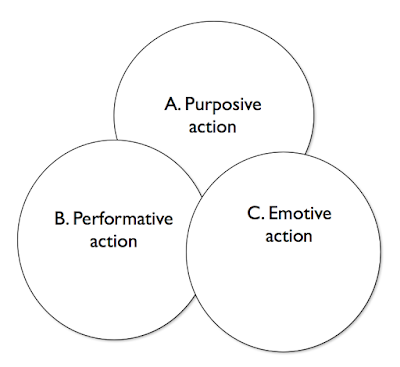
Would this modified scheme give a different orientation to the "sociological imaginary"? Might we imagine that the theories of important intersectional figures like Bourdieu, Tilly, or Foucault might fall in the intersection of all three circles? Would episodes of contentious politics involve actions that are purposive, emotive, and performative? Is there any reason (parsimony, perhaps) to attempt to reduce emotion and performance to a different kind of purpose? Or it is better to honestly recognize the diversity of kinds of action and motivation? My inclination is to think that Coleman's choice here reflects "rational choice fundamentalism" -- the idea that ultimately all human actions are driven by a calculation of consequences. And this assumption seems unjustified.
Tuesday, June 28, 2016
Complementarity of thick and thin theories of the actor

There is a range of approaches to the social sciences that fall under the umbrella of "actor-centered" theories (link). The chief fissure among these theories is that between "thin" and "thick" theories of the actor -- theories which provide less or more detail about the mental frameworks and beliefs of the actors being described. The extremes of the two types of theories range from pure rational choice theory to social psychology and ethnography. The two types of theories have complementary strengths and weaknesses. Thin theories, including especially rational choice theory and game theory, make use of a particularly sparse theory of the actor�s decision framework. This approach provides a basis for representing the motives and decisions of actors that can be readily incorporated into powerful techniques of simulation and calculation. Thick theories, including pragmatist and ethnomethodological theories, offer a basis for investigating particular social settings of action in detail, and they provide an in-depth basis for explaining and understanding the choices, judgments, and behavior of the individuals they study. But thick theories are not so readily incorporated into simulation models, precisely because they do not provide abstract, general characterizations of the individual�s action framework.
These comments make the contrast sound like a familiar set of oppositions: nomothetic explanation versus idiographic interpretation; causal explanation versus hermeneutic interpretation. And this in turn suggests that rational choice theory will be good at arriving at generalizations, whereas pragmatist and ethnographic theories will be good at providing satisfying interpretations of the actions of individuals in concrete social and historical circumstances, but not particularly good at providing a basis for general explanations.
The situation is not quite so binary as this suggests, however. A central tool for actor-centered research is set of simulation techniques falling under the rubric of agent-based models. To date ABMs have tended to use thin theories of the actor to represent the players in the simulation. However, it is entirely possible for agent-based models to incorporate substantially greater levels of specificity and granularity about the action frameworks of the individuals in specific circumstances. An ABM can introduce different kinds of agents into a simulation, each of which embodies a specific set of beliefs and modes of reasoning. And it can be argued that this increase in granularity provides a basis for a better simulation of complex social processes involving heterogeneous kinds of actors.
For example, a simulation of the political appeal of a nationalistic politician like Donald Trump may benefit by segmenting the electorate into different categories of voters: white nationalists, aging blue-collar workers, anti-globalization young people, .... And the model should represent the fact that actors in these various segments have substantially different ways of making political judgments and actions. So ABM simulations can indeed benefit from greater �thickness� of assumptions about agents. (This was illustrated in the discussion of the Epstein rebellion model earlier; link.)
On the other hand, it is possible to use RCT and DBO theories to illuminate historically particular instances of action -- for example, the analysis of historically situated collective action along the lines of Margaret Levi's review in "Reconsiderations of Rational Choice in Comparative and Political Analysis" (link). These theories can be applied to specific social circumstances and can provide convincing and satisfying interpretations of the reasoning and actions of the agents who are involved. So narrative explanations of social outcomes can be constructed using both thick and thin assumptions about the actors.
Moreover, the explanatory strength of thick theories is not limited to the degree to which they can be incorporated into formal simulations -- what can be referred to as "aggregation dynamics". It is clear that real explanations of important phenomena emerge from research by sociologists like Michele Lamont in Money, Morals, and Manners: The Culture of the French and the American Upper-Middle Class (link), Al Young in The Minds of Marginalized Black Men: Making Sense of Mobility, Opportunity, and Future Life Chances (link), and Erving Goffman in Behavior in Public Places: Notes on the Social Organization of Gatherings (link). We understand better the dynamics of the French professional classes, inner city neighborhoods, and asylums when we read the detailed and rigorous treatments that micro-sociologists provide of these social settings.
What this suggests is that analytical sociology would be well advised to embrace pluralism when it comes to theories of the actor and methods of application of actor-based research. Thick and thin are not logical contraries, but rather complementary ways of analyzing and explaining the social worlds we inhabit.
Subscribe to:
Posts
(
Atom
)


