Showing posts with label Pub year 2016. Show all posts
Wednesday, September 28, 2016
Recommended: WE SANG YOU HOME by Richard Van Camp and Julie Flett
In the last month or so I've been using the phrase "being loved by words" or "being loved by a book." I don't know if that works or not. Some might think it sounds goofy. It does, however, capture how I felt, reading the stories in Love Beyond Body, Space, and Time: An LGBT and Two Spirit Science Fiction Anthology. It is definitely a book I recommend to young adults.
The emotions it brought forth in me are spilling over again and again, of late. I don't know what to make of that tenderness that I feel, but it is real.
Around the same time that I read the anthology, I got an electronic copy of We Sang You Home by Richard Van Camp and Julie Flett. I had that same response to it. Indeed, there were moments when I was blinking back tears! Now, I've got a copy:

I've thought about it a lot since first reading it, trying to put words to emotions. Richard Van Camp and Julie Flett are Native. I've read many of their books and recommend them over and over. Working together on this one (their first one is Little You), or apart, the books they give us are the mirrors that Native children need.
Just look at the joy and the smile of the child on the cover! That kid is loved, and that's what I want for Native kids! To feel loved by words, by story, by books.
We Sang You Home is a board book that, with very few words on each page, tells a child about how they were wanted, and how they came to be, and how they were, as the title says, sang home where they'd be kissed, and loved, and... where they, too, would sing.
Here's me, holding We Sang You Home. See the joy on my face? Corny, maybe, but I wanna sing. About being loved, by this dear board book.

I highly recommend We Sang You Home. Published by Orca in 2016, it is going to be gifted to a lot of people in the coming years.
The emotions it brought forth in me are spilling over again and again, of late. I don't know what to make of that tenderness that I feel, but it is real.
Around the same time that I read the anthology, I got an electronic copy of We Sang You Home by Richard Van Camp and Julie Flett. I had that same response to it. Indeed, there were moments when I was blinking back tears! Now, I've got a copy:
I've thought about it a lot since first reading it, trying to put words to emotions. Richard Van Camp and Julie Flett are Native. I've read many of their books and recommend them over and over. Working together on this one (their first one is Little You), or apart, the books they give us are the mirrors that Native children need.
Just look at the joy and the smile of the child on the cover! That kid is loved, and that's what I want for Native kids! To feel loved by words, by story, by books.
We Sang You Home is a board book that, with very few words on each page, tells a child about how they were wanted, and how they came to be, and how they were, as the title says, sang home where they'd be kissed, and loved, and... where they, too, would sing.
Here's me, holding We Sang You Home. See the joy on my face? Corny, maybe, but I wanna sing. About being loved, by this dear board book.
I highly recommend We Sang You Home. Published by Orca in 2016, it is going to be gifted to a lot of people in the coming years.
Sunday, September 25, 2016
"Totem pole" will not appear in future printings of Robin Talley's AS I DESCENDED
On Friday, I read On Making Mistakes on Robin Talley's Tumblr page. There, she wrote:
In short: they listened.
Talley wrote that she'd shared that reader's message with her editor, Kristen Pettit at Harper Teen, and that the term will be taken out of future printings of the book. Here's the photo of the page that Talley posted:

The line is "Maria was almost as high up the totem pole as Delilah." I'm guessing that the book's title "As I Descended" is a reference to that totem pole. My guess is that Delilah is going to descend from a high point on the social status hierarchy.
The book itself has nothing to do with Native peoples. I haven't read it, so do not want anyone to think that this post is an endorsement of the book.
In her post, Talley apologized:

In brief:
1) A Native reader wrote to Talley.
2) Talley listened.
3) Talley wrote to her editor.
4) Talley and her editor are revising that line.
5) Talley wrote about this error, publicly.
Change happens, when we speak up, and when we listen. With more of this speaking up, and listening, I feel optimistic that change can happen.
Update: November 8, 2016
As I Descended is published by Harper Teen.
Two weeks ago, my latest book, As I Descended, was released. One week later, I received an anonymous message from a thoughtful reader who�d just started the book. This reader, who�s Indigenous, noticed that I�d used the term totem pole in chapter 1 to describe where a character stood in her school�s social hierarchy ? in the sense of the phrase �low man on the totem pole.�Talley's response to that reader was similar to the one I got from Sarah McCarry when I wrote to her about that phrase in her book (see her post), and the response I got from Ashley Hope Perez when I wrote to her about the phrase in her book (see my post).
In short: they listened.
Talley wrote that she'd shared that reader's message with her editor, Kristen Pettit at Harper Teen, and that the term will be taken out of future printings of the book. Here's the photo of the page that Talley posted:
The line is "Maria was almost as high up the totem pole as Delilah." I'm guessing that the book's title "As I Descended" is a reference to that totem pole. My guess is that Delilah is going to descend from a high point on the social status hierarchy.
The book itself has nothing to do with Native peoples. I haven't read it, so do not want anyone to think that this post is an endorsement of the book.
In her post, Talley apologized:
I profoundly regret that I used the term this way, and I apologize to any readers who have been hurt by it.I shared Talley's Tumblr post, adding this:
Really glad to see another person speak up about this, and another writer and editor acknowledge its use as being wrong! Very glad it�ll come out of the next printings, too, and that it is all being made public for us to know! Thank you, Robin!
A thought, though, about apologies.
I get why people offer them. They�re a social grace. But sometimes, they carry some things that don�t work. They suggest that __ is hurt by the word that misrepresents their particular demographic, when maybe __ isn�t actually hurt. Maybe __ is just pissed off. Yeah, I know, being angry can be characterized as hurt. Still, though, saying someone of that demographic is the one who should be apologized to suggests they�re the only one who is hurt by the word, when I think everyone who doesn�t know it is a problem is impacted by it.
Instead of �I profoundly regret that I used the term this way, and I apologize to any readers who have been hurt by it,� maybe something like (and yeah, I know, this is pretty audacious of me to tell someone how to apologize, but I think we�re talking about larger issues) �I messed up. I didn�t know I was messing up. Lot of us don�t know. Let�s not do that, ok, ourselves, anymore, ok? And let�s tell others about it, too.�On Twitter, I retweeted her "On Making Mistakes" tweet, and that I had a response to her post (crossing lot of social media platforms with this post!). Talley replied that she agrees with my points.
In brief:
1) A Native reader wrote to Talley.
2) Talley listened.
3) Talley wrote to her editor.
4) Talley and her editor are revising that line.
5) Talley wrote about this error, publicly.
Change happens, when we speak up, and when we listen. With more of this speaking up, and listening, I feel optimistic that change can happen.
Update: November 8, 2016
As I Descended is published by Harper Teen.
Thursday, September 22, 2016
Not recommended: THE COURAGE TEST by James Preller
People have been asking me about James Preller's The Courage Test. I got a copy of it, and it was in line for a "Debbie--have you seen" post. On September 20, 2016, a conversation on Facebook prompted me to move it up in the line.
Here's the synopsis:
Bruce's reverence for the expedition is evident as I read The Courage Test. As they travel, Bruce tells Will about the expedition, how Lewis and Clark were seeing a "new world" (p. 22) and "things that had never before been seen by white men" (p. 27). He gives Will a copy of O'Dell and Hall's Thunder Rolling in the Mountains to read. If it is anything like what I read in Island of the Blue Dolphins, it is a poor choice if Bruce's intent is for Will to learn about the Nez Perce people.
Time and again as I read The Courage Test, I thought "oh come on..." But, there it is. In some places, Will says or thinks something that puts a bit of a check on his dad's reverence, but for the most part, he's in awe, too, and uses the same kind of words his dad uses. Scattered throughout, for example, are pages from a journal Will uses. In the first one, "My Summer Assignment" he writes that (p. 17):
Jumping back into the story of Bruce and Will on their journey, we meet a guy with broad shoulders, high cheekbones, tanned/rugged/deeply lined skin, black hair in two long thick braids, wearing a beaded necklace. Of course, he's Native. His name is Ollie. He's Bruce's friend, from grad school. Ollie is Nez Perce. When he tells Will about his ancestors, I think it would work better if he used "us" words rather than "them" words:
And then later, Will watches Ollie fix his hair (p. 74):
I said above that I stuck with this book. That hair style part was tough. So is the part where Ollie tells Will that the bear he thinks he saw the night before was not a real bear (Will didn't see any tracks)... it was probably a spirit animal. They, Ollie tells Will, occur when someone is on a vision quest. It comes, he says, to "bestow the animal's power" and is a "great gift" that he must accept (p. 81). Later in the story, Will has an encounter with a bear. He froze, unable to do what he planned to do if he came across a bear (he's prepped for it), and thinks he's a failure. So.... I guess the power of the "spirit animal" didn't work... in that moment. Will's major task in this book is to be ready for dealing with his mother's cancer. Maybe that's what he'll need the power of that "spirit animal" for, but, really. This is all a mess. So is how the dreamcatcher is shown, later. So is the "illegal" they meet and help out.
I've got more notes, but I think what I've shared here is enough. Published in 2016 by Feiwel and Friends--an imprint of MacMillan--I do not recommend James Preller's The Courage Test.
Here's the synopsis:
Will has no choice. His father drags him along on a wilderness adventure in the footsteps of legendary explorers Lewis and Clark--whether he likes it or not. All the while, Will senses that something about this trip isn't quite right.
Along the journey, Will meets fascinating strangers and experiences new thrills, including mountain cliffs, whitewater rapids, and a heart-hammering bear encounter.
It is a journey into the soul of America's past, and the meaning of family in the future. In the end, Will must face his own, life-changing test of courage.
A father-and-son journey along the Lewis and Clark Trail--from Fort Mandan to the shining sea--offers readers a genre-bending blend of American history, thrilling action, and personal discovery.Will's dad, Bruce, is a history professor. He's into Lewis and Clark so much, that he named his son William Meriwether Miller (William for William Clark, and Meriwether for Meriwether Lewis).
Bruce's reverence for the expedition is evident as I read The Courage Test. As they travel, Bruce tells Will about the expedition, how Lewis and Clark were seeing a "new world" (p. 22) and "things that had never before been seen by white men" (p. 27). He gives Will a copy of O'Dell and Hall's Thunder Rolling in the Mountains to read. If it is anything like what I read in Island of the Blue Dolphins, it is a poor choice if Bruce's intent is for Will to learn about the Nez Perce people.
Time and again as I read The Courage Test, I thought "oh come on..." But, there it is. In some places, Will says or thinks something that puts a bit of a check on his dad's reverence, but for the most part, he's in awe, too, and uses the same kind of words his dad uses. Scattered throughout, for example, are pages from a journal Will uses. In the first one, "My Summer Assignment" he writes that (p. 17):
When Thomas Jefferson was president, a lot of North America was unexplored. No white American had ever seen huge parts of it.I grew tired of all that pretty quickly. I stuck with it, though, right to the end, to Preller's notes in the final pages. There, Preller wrote (p. 209):
I owe the greatest debt to Undaunted Courage by Stephen E. Ambrose, The Journals of Lewis Clark edited by Bernard DeVoto, Lewis and Clark Through Indian Eyes: Nine Indian Writers on the Legacy of the Expedition by Alvin M. Josephy Jr., Lewis and Clark Among the Indians by James P. Ronda, and Traveling the Lewis and Clark Trail by Julie Fanselow.
Of that list, the one edited by Alvin Josephy, Jr. stands out. The first Native writer in Josephy's book is Vine Deloria, Jr. Deloria's work is of fundamental importance to Native peoples, and to Native studies. Have you read, for example, his Custer Died For Your Sins? The first sentence in his chapter, �Frenchmen, Bears, and Sandbars� is this (p. 5):
Exaggeration of the importance of the expedition of Lewis and Clark is a typical American response to mythology.If Preller read Deloria carefully, how is it that he has such celebratory language all through The Courage Test? And, there's this, on page 6-7 (bold is mine) in Deloria's chapter:
We have traditionally been taught to believe that the Lewis and Clark expedition was the first penetration of white men into the western lands. This belief is totally unfounded. The location of the Mandan villages, scattered from the present North Dakota-South Dakota line along the Missouri River to some distance above present-day Bismarck, were already common knowledge. French and British traders had already established a thriving commerce with these villages and the sedentary Indians were accustomed to dealing with foreigners.Did Preller choose to ignore that? Or... did Will (writing in his journal) think that the French and British didn't count as "White Americans"? It just doesn't seem to me that Preller actually brought any of the writings in Josephy's book to bear on what he wrote in The Courage Test. Listing Josephy's book, then, feels... not right.
Jumping back into the story of Bruce and Will on their journey, we meet a guy with broad shoulders, high cheekbones, tanned/rugged/deeply lined skin, black hair in two long thick braids, wearing a beaded necklace. Of course, he's Native. His name is Ollie. He's Bruce's friend, from grad school. Ollie is Nez Perce. When he tells Will about his ancestors, I think it would work better if he used "us" words rather than "them" words:
"My people, the Nez Perce, crossed this river not far from here in 1877. They hoped the Crow would join them in their fight against the U.S. Army, but the Crow turned their backs."I'm not keen on his characterization of the Nez Perce being like deer grazing on the grass, while the white people were like the grizzly. It has a doomed quality to it that--while plausible--doesn't work for me. Later when Bruce and Ollie share a drink of whiskey, they tell Will that soldiers got flogged for getting drunk. Bruce goes on, saying (p. 69):
Remember, Will, this was a military operation. They were headed into hostile territory.Bruce says that, with his Nez Perce friend, sitting right there, beside him. Don't his words, then, seem.... odd? Let me frame it this way, for clarity. Let's say I'm camping on my homelands. One of my dear friends and her kid are there, too. We're sharing a drink and talking about colonization. That dear friend would not say to her kid "Remember, ___, this was a military operation. They were headed into hostile territory." She might do it out of the blue in a cafe in a city somewhere, but if we were having a drink around a campfire ON MY HOMELAND and talking about something like the Lewis and Clark expedition... that friend wouldn't do that! And if she did, I'd say something. So---why didn't Ollie say something?!
And then later, Will watches Ollie fix his hair (p. 74):
He fusses with his front forelock, stylishly sweeping it up and to the back.
"Going for a different look today?" I joked.
Ollie frowns. "It is the style of my people. Goes back generations. Don't you like it?"
"I definitely do," I say.You know what "style" he's trying to do? Do a search on Chief Joseph, and you'll see. Now it is plausible that a Nez Perce man who is an investment banker in Brooklyn might go home and do his hair that way, but I'm kind of doubtful. (Also, though "forelock" is also used to refer to hair people have, it comes across more strongly for me as specific to horses, so that is a bit odd, too. Not that he's equating Ollie with animals, but that it is just an unusual word.)
I said above that I stuck with this book. That hair style part was tough. So is the part where Ollie tells Will that the bear he thinks he saw the night before was not a real bear (Will didn't see any tracks)... it was probably a spirit animal. They, Ollie tells Will, occur when someone is on a vision quest. It comes, he says, to "bestow the animal's power" and is a "great gift" that he must accept (p. 81). Later in the story, Will has an encounter with a bear. He froze, unable to do what he planned to do if he came across a bear (he's prepped for it), and thinks he's a failure. So.... I guess the power of the "spirit animal" didn't work... in that moment. Will's major task in this book is to be ready for dealing with his mother's cancer. Maybe that's what he'll need the power of that "spirit animal" for, but, really. This is all a mess. So is how the dreamcatcher is shown, later. So is the "illegal" they meet and help out.
I've got more notes, but I think what I've shared here is enough. Published in 2016 by Feiwel and Friends--an imprint of MacMillan--I do not recommend James Preller's The Courage Test.
Saturday, September 17, 2016
Not recommended: GHOSTS by Raina Telgemeier

Anytime I see a book that has something to do with ghosts, I wonder if the author is going to be contributing to the too-high-pile of problematic books with characters who are haunted or inspired by the ghost of a Native character. One example (there are many) is Susan Cooper's Ghost Hawk.
I think Telgemeier's Ghosts is one of those problematic books, but I don't think that Telgemeier is aware that she's doing that same thing. The story she tells, and the reviews of her story, demonstrate (yet again) an ignorance of history. I imagine some people defending the book by saying its audience isn't old enough for the complexity of that history, but that holds true only for a selected (possibly white) audience. Native children, and children of color, know far more history than one might expect, because history informs and shapes our daily lives, today. History, of course, informs the daily lives of White children, too, but in a way that means they're ignorant--and are taught ignorance--until they're deemed "ready" for that dark history.
So, let's get started. Here's the synopsis for Telgemeier's Ghosts:
Catrina and her family are moving to the coast of Northern California because her little sister, Maya, is sick. Cat isn't happy about leaving her friends for Bah�a de la Luna, but Maya has cystic fibrosis and will benefit from the cool, salty air that blows in from the sea. As the girls explore their new home, a neighbor lets them in on a secret: There are ghosts in Bah�a de la Luna. Maya is determined to meet one, but Cat wants nothing to do with them. As the time of year when ghosts reunite with their loved ones approaches, Cat must figure out how to put aside her fears for her sister's sake - and her own.
The ghosts in Bah�a de la Luna (that is a fictional town) are primarily the ones they see at a mission. This starts on page 73, when Carlos (the neighbor boy who tells them about ghosts) takes them to the mission, "where the ghosts' world and ours mostly closely overlap." The three get separated on the way up there. Cat arrives, alone. The mission itself is run down.

Nobody is there, which is interesting in itself because those missions are a key piece of California's tourism industry. There may be some that are like the one in Ghosts, but I kind of doubt it. After wandering around a bit, Cat sees a ghost. She follows it and finds Maya and Carlos in the courtyard:

Carlos opens a bottle of orange soda, hands it to Maya, and then one of the ghosts goes right up to her, smiling:

At first she's taken aback, but in the next panels, we see the ghost hug her, so she decides it is a friendly ghost. She says hi, but Carlos tells her that most of the people buried there were from Mexico, so, they like it when people speak Spanish to them. So, Maya calls out "Hola!"
That visit to the mission is the point where--for me--the story really starts to unravel.
The missions were there (obviously) for a specific reason: to turn Native peoples into Catholics and to claim that land for Spain. Some see missions and missionary work as a good, but if you pause for a minute and think about what they and that work is designed to do, and if you do a bit of reading, you'll learn that it was far from the benevolent character with which it is regarded by most of society.
At the missions, life for Native people was brutal. There was rape. Enslavement. Whippings. Confinements. And of course, death. Analyses of the bones at the mission burial sites that compare them with bones found elsewhere show that the bones of those who died at the missions were stunted and smaller than the others.
Some of Telgemeier's ghosts might have spoken Spanish, but it is far more likely that their first language was an Indigenous one. Did they joyfully want to be spoken to in Spanish, the language of their oppressors? Given the history, I think it is unlikely that these ghosts would be smiling as Telgemeier shows:

And I wonder, too, about those cemeteries. There are a lot of accounts that report that Native peoples were buried in mass, unmarked graves, elsewhere.
One might defend Telgemeier by saying that her ghosts are of the Spanish priests and maybe soldiers, and, maybe Native peoples who had been successfully Christianized, but the overwhelming evidence of the history is what I think should hold sway when we look at the missions, and when we give children stories about them.
I strongly urge people to read Deborah Mirandah's Bad Indians. Look, especially, at her chapter, The End of the World: Missionization. There, she presents an accurate version of what children across California are asked to do: a mission study. But Deborah's doesn't soft pedal or whitewash what happened. She describes items, like a cudgel (p. 15):
Wooden club used to strike quickly; alcaldes, soldiers, and sometimes padres carried these with them for spontaneous corrections throughout their day. The alcaldes used these during services in church to remind the Indians to be quiet, to pay attention, and to stay awake. A longer cudgel or cane was useful during Mass because the alcalde could reach far into a crowd without having to move very much.Look, too, at A Cross of Thorns: The Enslavement of California's Indians by the Spanish Missions by Elias Castillo. He writes about treatment of Native people who tried to escape the missions. When caught, the friars at Mission San Francisco burned crosses into the faces of men, women, and children.
If you can't get Bad Indians or A Cross of Thorns right away, then read The Lesser-Told Story of the California Missions, which includes quotes from their books.
Above, I wrote that this brutal history is usually kept away from children--but I also noted that the children it is kept from is not Native children, or children of color. Indeed, Castillo's book includes a foreword, written by Valentin Lopez, Chair of the Amah Mutsun Tribal Band of the Costanoan/Ohlone Indians. He writes:
Until now, the true and full history of the California missions has never been told. When visitors tour the missions, they are usually presented with stories and images of peaceful, loving priests and soldiers who treated the Indians as adored children.
These stories belie the truth of the missions, where Native Americans suffered under harsh and brutal conditions. As a young boy, I listened to stories from my elders about the cruelty of the missions. There were tales of how native women were captured� with their thumbs tied together with leather straps to form human chains� and marched forcibly from their tribal lands to the missions. If the Indians did not cooperate, the soldiers, at times, killed them. In one incident, more than two hundred women and children of the Orestimba tribe (living near what is now the town of Newman) were being taken to Mission San Juan Bautista. When, after passing the summit at the Orestimba Narrows, these women refused to go any farther, the Spanish commander ordered the women and children killed with sabers and their remains scattered.
The oral traditions of our tribal band, the Amah Mutsun, taught us stories of how certain Spaniards would appear when the Indians were first brought into the missions so they could get their pick of the young girls and boys for their perverted appetites, always with the tacit approval of the priests.I know most people don't want to read about such things, but for certain, we cannot go forward presenting the missions as Telgemeier does. Can you imagine what Mr. Lopez's response to Ghosts? Can you imagine how teachers will use this book in the classrooms? On a superficial level, it looks to be the perfect "diverse" book. It isn't. Head over to Reading While White's post about Ghosts and see the conversation and links there. In particular see what Yuji Morales and Patricia Encisco submitted in their comments about the book.
Published in 2016 by Scholastic, I do not recommend Raina Telgemeier's Ghosts.
__________
Eds. Note: AICL will add links to additional reviews about concerns with the book.
- A Look at Ghosts by Faythe Arrendondo
- Ghosts: Swing and a Hard Miss by Laura Jimenez
- Ghosts by Beverly Slapin
Thursday, September 1, 2016
Re-reading (and again, not recommending) Nancy Bo Flood's SOLDIER SISTER, FLY HOME
Back in January of 2016, I read the ARC of Nancy Bo Flood's Soldier Sister, Fly Home. I did not recommend it. I'm back today, with a review of the electronic copy of the book.
In the prologue, we learn that the protagonist, Teshina, is a 13-year-old "half Navajo" and that she looks White. Her sister, Gaby, who is six years older than she is, looks "like a woman warrior with gorgeous long hair." That information foreshadows a recurring theme in Flood's book, which is indicated by the first part of the book's description:
As I read and compare the ARC I had in January with the electronic copy I have now, I see that Flood made some changes, maybe some that are based on my review in January. I noted, for example, her use of the word "ceremony" several times to describe the memorial Teshina (Tess) was going to attend for Lori Piestewa. A "ceremony" and a "memorial" are really different, so I'm glad Flood made those changes in the story.
As the story opens, we learn that Tess is upset that her older sister, Gaby, enlisted in the army. Gaby had a future. She wanted to go to med school. Because she was a track star, she was planning on athletic scholarships to cover costs to go to college. But--she got thrown off her horse and broke her ankle. No more running, no more athletic scholarship, no college. She decides to enlist in the army.
The thing is... in real life? Navajo Nation has scholarship monies. She could have applied for them. In the story, though, we're told that she didn't learn to read until junior high school, so maybe her grades aren't very good enough to apply for, say, the Chief Manuelito scholarship. But we also know that she wants to go to med school, which suggests she's doing well in the sciences. A small point, perhaps, to someone who doesn't know about scholarship monies that tribes have set up, but they're important.
In chapter four, Gaby is back home for a visit. When she comes into the house (Tess lives in a modern home; next to it is her grandparents hogan, where they live), Tess notices that she no longer has her gorgeous long black hair. Tess wants to hug her but waits as Gaby greets their grandparents, and then when Gaby hugs their mom, Tess sees her crying (Kindle location 258-259):
Later, in her room, she waits for Gaby to come upstairs. She remembers times when she'd comb Gaby's hair, that Gaby had said she'd never cut it, and how different it is from her own "boring brown" hair. Gaby tells Tess that she's being deployed to Iraq. Tess is upset and they argue, with Tess asking Gaby if she wants to be a war hero, dead or alive. Gaby shakes her head, saying she doesn't want that, but that (Kindle location 385-386):
The title for chapter seven is "protection ceremony" (lower case is the style used throughout the book). Tess's dad is outside chopping and stacking wood in exactly the way the medicine man told him to do it. She remembers other ceremonies, when people would sit cross legged with their backs against the walls of the hogan, facing the medicine man who sat in the center, "the place of honor." Tess tells us a few details of the ceremonies she's been to. I don't recount such things in my reviews because tribal nations generally protect those ceremonies from outsiders. I respect their decisions to keep such things private.
Tess is in the kitchen for awhile but then goes outside with her grandpa who recounts how he felt the night before his brother left for war. He didn't go to his brother's ceremony. He tells her that he was scared, and then says (Kindle Location 626-627):
Tess helps him butcher a lamb for the stews they'll serve at the ceremony but then she does what her grandfather did: she doesn't go to her sister's ceremony. Instead she watches from a high place near the hogan, falls asleep, wakes at dawn, and waits outside the hogan for Gaby to come out. They visit a bit more before Gaby has to leave for Phoenix. The two girls text each other. Tess sends Gaby a poem:
The school year ends, and Tess is home from her boarding school in Flagstaff. She didn't like being there, where the White students taunted her, calling her names like "Pokeyhontas." She goes into town with Shima (her grandmother), where a little white girl named Rebecca yells out "Look, a real Indian!" and points at Tess's grandmother, who answers Rebecca's question and agrees to have her photo taken. Rebecca is with Megan, one of the girls in Tess's school. After their brief conversation, Tess's grandmother shakes hands with Rebecca and tells her (Kindle Location 868):
As Tess and her grandmother go inside the trading post, Tess looks at her grandmother and thinks that she is as real as Indians can be, but wonders about herself. The two are there to sell a rug. Her grandmother is well known for her rugs. Does that, Tess wonders, maker her a real Indian?
As her grandmother and Mr. Snow, the owner of the trading post barter, in Navajo, Tess continues to wonder about what makes someone "a real Indian." She didn't go to her sister's ceremony, and she doesn't weave rugs or speak much Navajo. Mr. Snow speaks Navajo, but he's clearly not Navajo. She thinks about her grandfather who was a Code Talker, but he didn't go to his brother's ceremony and that made him wonder about his Native identity, too. Tess watches her grandma and Mr. Snow shake hands (Kindle Location 896):
Tess and her grandmother leave the trading post. Outside, they talk about the interaction with Rebecca. Her grandma reminds her that pointing is rude "especially if you are a real Indian: and then tells her that (Kindle Location 905):
Grandma checks her email and has one, from Gaby. It opens with this:
Later in the story, Tess goes with her grandmother to sheep camp. There, on a shelf, is a book of poems by Emily Dickenson. Tess pulls it off the shelf and sees that one page has been marked. Her grandmother asks her to read it aloud. Before she gets to the end, her grandmother joins her and they recite the last stanza together. She tells Tess it is a good poem and that (Kindle Location 1354-1357):
Then, Tessa's grandma talks about Becca, the little girl, and what Becca saw (Kindle Location 1387-1389):
A few days later, Tess's grandma gives her some moccasins for an upcoming ceremony. The description feels off to me ("white doeskin with suede bottoms"). Several times, Tess dreams about Y�ii, and as noted earlier, several times she talks about ceremony.
All of this makes me uneasy, as does the many times when Tess, her sister, or her grandmother talk about how it isn't very Navajo to talk about death--and then do it anyway. It seems to me that in this story about a young girl wrestling with her half Navajo/half White identity, Flood is giving the world characters who flaunt Navajo teachings.
The last line in the story is "All has become beauty again." For Tess, I suppose that is so, but using that 'beauty' reference to Navajo teachings bothers me. Those five words capture so much of what I find wrong with the book. Laden with ceremony and stereotypes.... it doesn't work, for me.
In the Acknowledgements, Flood writes that Navajo elders and educators have reviewed the manuscript to ensure that her portrayals of culture and language are authentic, accurate, and sensitive. She goes on to say "Any inaccuracies are my own." I don't know what to make of that. If those elders found it to be authentic, accurate, and sensitive, why does she need the "any inaccuracies are my own" at all? She goes on to say that she lived and taught on the Navajo Nation for 15 years and that the story was inspired by her incredible Navajo students. She talks about all the things she did for them. I think she tells us all this so that we think she is a good person, helping Navajo youth. She doesn't have to do that. I believe we can all assume that she means well. Putting all that, and her desire to honor Lori Piestewa in the Acknowledgements isn't necessary.
Today (September 1, 2016) I learned that Flood received a $2,000 award from the Society of Children's Book Writers and Illustrators (SCBWI) for this book. That is disappointing. In the Acknowledgements, she writes that the award is the Work-in-Progress multicultural one, which makes me all the more disappointed.
I think of all the Native writers who SCBWI ought to be helping and wish one of them had been the recipient of this award. Writing about identity is hard. I don't think Flood pulled it off. I'd much prefer to read something by a Navajo writer, wouldn't you?
To sum up: I do not recommend Nancy Bo Flood's Soldier Sister, Fly Home, published by Charlesbridge in 2016.
In the prologue, we learn that the protagonist, Teshina, is a 13-year-old "half Navajo" and that she looks White. Her sister, Gaby, who is six years older than she is, looks "like a woman warrior with gorgeous long hair." That information foreshadows a recurring theme in Flood's book, which is indicated by the first part of the book's description:
Thirteen-year-old Tess is having a hard enough time understanding what it means to be part white and part Navajo...Later in the story, we learn that Tess's dad is White, a Vietnam vet, and welcome at ceremonies. Flood is White. To tell this story, the publisher's website says that she "draws thoughtfully on her experience living for fifteen years in the Navajo Nation."
As I read and compare the ARC I had in January with the electronic copy I have now, I see that Flood made some changes, maybe some that are based on my review in January. I noted, for example, her use of the word "ceremony" several times to describe the memorial Teshina (Tess) was going to attend for Lori Piestewa. A "ceremony" and a "memorial" are really different, so I'm glad Flood made those changes in the story.
As the story opens, we learn that Tess is upset that her older sister, Gaby, enlisted in the army. Gaby had a future. She wanted to go to med school. Because she was a track star, she was planning on athletic scholarships to cover costs to go to college. But--she got thrown off her horse and broke her ankle. No more running, no more athletic scholarship, no college. She decides to enlist in the army.
The thing is... in real life? Navajo Nation has scholarship monies. She could have applied for them. In the story, though, we're told that she didn't learn to read until junior high school, so maybe her grades aren't very good enough to apply for, say, the Chief Manuelito scholarship. But we also know that she wants to go to med school, which suggests she's doing well in the sciences. A small point, perhaps, to someone who doesn't know about scholarship monies that tribes have set up, but they're important.
In chapter four, Gaby is back home for a visit. When she comes into the house (Tess lives in a modern home; next to it is her grandparents hogan, where they live), Tess notices that she no longer has her gorgeous long black hair. Tess wants to hug her but waits as Gaby greets their grandparents, and then when Gaby hugs their mom, Tess sees her crying (Kindle location 258-259):
It scared me. Mom never cried like that. Tears at Lori�s memorial, but not many. Mom was always so Navajo about not showing much emotion.A moving scene? Maybe, but I read that bit about Navajo people not showing emotion as the stereotypical stoic Indian. It might sound good to readers who aren't Native, or aren't Navajo, but I ran that line by Navajo friends... Suffice it to say that they had pointed and amused responses to it.
Later, in her room, she waits for Gaby to come upstairs. She remembers times when she'd comb Gaby's hair, that Gaby had said she'd never cut it, and how different it is from her own "boring brown" hair. Gaby tells Tess that she's being deployed to Iraq. Tess is upset and they argue, with Tess asking Gaby if she wants to be a war hero, dead or alive. Gaby shakes her head, saying she doesn't want that, but that (Kindle location 385-386):
�I�m trying to figure it out, Tess, how to be me. Navajo? White? What�s me?"Because Gaby is being deployed to Iraq, her family decides to have a ceremony for her before she leaves, in two days. In chapter six, the two girls argue again. Tess says (Kindle Locations 553-554):
"Why did you sign up in the first place? Trying to be a war hero? Trying to be Navajo?"
I am Navajo, Tess. Same as you!"
"Wrong! We're mixed bloods, half-breeds. Misfits. Kids at school remind me every day."
I've told you, Tess--ignore them. They'll stop."
"It doesn't work that way for me. You're the gorgeous Navajo princess. I'm the kid who looks like a mixed-up mutt."The chapter ends with the fight over and Tess promising she'll take care of Gaby's horse. In return, Gaby promises to come home from Iraq, safe.
The title for chapter seven is "protection ceremony" (lower case is the style used throughout the book). Tess's dad is outside chopping and stacking wood in exactly the way the medicine man told him to do it. She remembers other ceremonies, when people would sit cross legged with their backs against the walls of the hogan, facing the medicine man who sat in the center, "the place of honor." Tess tells us a few details of the ceremonies she's been to. I don't recount such things in my reviews because tribal nations generally protect those ceremonies from outsiders. I respect their decisions to keep such things private.
Tess is in the kitchen for awhile but then goes outside with her grandpa who recounts how he felt the night before his brother left for war. He didn't go to his brother's ceremony. He tells her that he was scared, and then says (Kindle Location 626-627):
"I even thought that maybe I wasn't a real Indian. Maybe not a real brother."There again, we have an identity question. In this case, it is a Navajo man thinking that his being scared might mean he couldn't be Indian. I guess he thinks he's supposed to be fearless. But that--like the Navajo mom who doesn't show emotion--is another stereotypical depiction.
Tess helps him butcher a lamb for the stews they'll serve at the ceremony but then she does what her grandfather did: she doesn't go to her sister's ceremony. Instead she watches from a high place near the hogan, falls asleep, wakes at dawn, and waits outside the hogan for Gaby to come out. They visit a bit more before Gaby has to leave for Phoenix. The two girls text each other. Tess sends Gaby a poem:
Ten little IndianObviously with that poem, Flood has the 13 year old character riffing off of the racist rhyme, Ten Little Indians, but why? Is it an attempt, by Flood, to recast that horrid rhyme? Is it necessary to do that? Is it necessary, for this story?
girls
grew up.
One became a doctor,
two work in Phoenix,
three went to college,
two got married,
one was a
warrior.
And the last
little Indian,
a soldier-girl Indian,
ran, ran, ran, all the way,
all the way
home.
The school year ends, and Tess is home from her boarding school in Flagstaff. She didn't like being there, where the White students taunted her, calling her names like "Pokeyhontas." She goes into town with Shima (her grandmother), where a little white girl named Rebecca yells out "Look, a real Indian!" and points at Tess's grandmother, who answers Rebecca's question and agrees to have her photo taken. Rebecca is with Megan, one of the girls in Tess's school. After their brief conversation, Tess's grandmother shakes hands with Rebecca and tells her (Kindle Location 868):
�Now we both walk in beauty, in harmony.�
As Tess and her grandmother go inside the trading post, Tess looks at her grandmother and thinks that she is as real as Indians can be, but wonders about herself. The two are there to sell a rug. Her grandmother is well known for her rugs. Does that, Tess wonders, maker her a real Indian?
As her grandmother and Mr. Snow, the owner of the trading post barter, in Navajo, Tess continues to wonder about what makes someone "a real Indian." She didn't go to her sister's ceremony, and she doesn't weave rugs or speak much Navajo. Mr. Snow speaks Navajo, but he's clearly not Navajo. She thinks about her grandfather who was a Code Talker, but he didn't go to his brother's ceremony and that made him wonder about his Native identity, too. Tess watches her grandma and Mr. Snow shake hands (Kindle Location 896):
Mr. Snow extended his hand. They had agreed on a price. Grandma shook it once, gently, the Navajo way, like a real Indian.There may be protocols for the way that a Navajo woman would shake hands with a White man--or any man--but the use of "real Indian" here is jarring. It suggests there is a way that all Indians shake hands.
Tess and her grandmother leave the trading post. Outside, they talk about the interaction with Rebecca. Her grandma reminds her that pointing is rude "especially if you are a real Indian: and then tells her that (Kindle Location 905):
"When someone looks down on you, listen and learn. Walk with them.�Though her grandmother is laughing about the encounter, she's also sounding (to me) like the wise old Indian giving advice. Tess is surprised, when next they go to a coffee shop and her grandma orders a latte and then walks to a computer in the coffee shop (Kindle Locations 917-920):
I couldn�t believe what she did next. Sitting in front of the computer, wearing her velvet skirt, satin blouse, turquoise jewelry, and green sneakers, my real Indian shim� s�n� logged onto the internet as if she�d been doing it all her life. �Got mail,� she announced. If I had been holding a cup of coffee, I�d have dropped it.I get what Flood is trying to do, but this is kind of awkward. I think she means to make the point that Native people use the Internet. That scene might work if it was Rebecca (the white girl) making that observation, but it doesn't seem right, for Tess. I can imagine a Native kid being surprised at their grandma's technology skills... which makes the scene plausible, but here, it isn't working, for me, and it may be because it is a White writer doing this scene.
Grandma checks her email and has one, from Gaby. It opens with this:
Y��t���h, Greetings, Hello Shim� S�n�.That, too, strikes me as awkward. Native kids who speak their language and send email to their grandparents aren't likely to use a greeting in their own language, followed by, in this case, the word "Greetings" and "Hello." I might use a Tewa greeting followed by its translation in English, if I was talking to a White person, but to another Tewa speaker... that would be silly.
Later in the story, Tess goes with her grandmother to sheep camp. There, on a shelf, is a book of poems by Emily Dickenson. Tess pulls it off the shelf and sees that one page has been marked. Her grandmother asks her to read it aloud. Before she gets to the end, her grandmother joins her and they recite the last stanza together. She tells Tess it is a good poem and that (Kindle Location 1354-1357):
When I was in school, I thought, I am Navajo, I should not read that poem. It was written by a white woman. She could speak of death. We do not. But I read and reread that poem.� Shim� reached for the book. �Do you sometimes feel like that?�
�Like what?�
�The Navajo and white fight inside you?�Tess tells her about being called an apple "red on the outside, white in the middle" by the kids on the "Rez" (Flood uses a capital letter for R in rez) and "Indian princess, heap-big squaw" in school. She doesn't feel like she fits in with either group and asks her grandmother if it was like that when she went to school. Her grandmother tells her she was in boarding school. She tells Tess what it was like, and that she left without her diploma. When she got home, her parents saw how angry she was and arranged a Blessingway ceremony for her. The medicine man greeted her in English, which made her angry all over again. The medicine man told her that her Navajo and English fight, but that the ceremony will bring them together, and that both will be able to walk in her, with beauty.
Then, Tessa's grandma talks about Becca, the little girl, and what Becca saw (Kindle Location 1387-1389):
�She did not see me, Tess. She saw a real Indian grandma with real Indian jewelry. She did not see this woman who loves her sheep, her stubborn goats, and a strong hot latte, who reads Emily Dickinson and sends letters to Iraq on the internet. Becca�s eyes did not see these things.�That passage gives me pause, because in a way, it feels to me like Flood herself is Becca. Becca is the white gaze. She is so interested in real Indians. Flood--through her character--is so invested in figuring out what a real Indian is. I'll be thinking about how this passage offers some parallel to what Flood is trying to do with her writing of Navajo stories.
A few days later, Tess's grandma gives her some moccasins for an upcoming ceremony. The description feels off to me ("white doeskin with suede bottoms"). Several times, Tess dreams about Y�ii, and as noted earlier, several times she talks about ceremony.
All of this makes me uneasy, as does the many times when Tess, her sister, or her grandmother talk about how it isn't very Navajo to talk about death--and then do it anyway. It seems to me that in this story about a young girl wrestling with her half Navajo/half White identity, Flood is giving the world characters who flaunt Navajo teachings.
The last line in the story is "All has become beauty again." For Tess, I suppose that is so, but using that 'beauty' reference to Navajo teachings bothers me. Those five words capture so much of what I find wrong with the book. Laden with ceremony and stereotypes.... it doesn't work, for me.
In the Acknowledgements, Flood writes that Navajo elders and educators have reviewed the manuscript to ensure that her portrayals of culture and language are authentic, accurate, and sensitive. She goes on to say "Any inaccuracies are my own." I don't know what to make of that. If those elders found it to be authentic, accurate, and sensitive, why does she need the "any inaccuracies are my own" at all? She goes on to say that she lived and taught on the Navajo Nation for 15 years and that the story was inspired by her incredible Navajo students. She talks about all the things she did for them. I think she tells us all this so that we think she is a good person, helping Navajo youth. She doesn't have to do that. I believe we can all assume that she means well. Putting all that, and her desire to honor Lori Piestewa in the Acknowledgements isn't necessary.
Today (September 1, 2016) I learned that Flood received a $2,000 award from the Society of Children's Book Writers and Illustrators (SCBWI) for this book. That is disappointing. In the Acknowledgements, she writes that the award is the Work-in-Progress multicultural one, which makes me all the more disappointed.
I think of all the Native writers who SCBWI ought to be helping and wish one of them had been the recipient of this award. Writing about identity is hard. I don't think Flood pulled it off. I'd much prefer to read something by a Navajo writer, wouldn't you?
To sum up: I do not recommend Nancy Bo Flood's Soldier Sister, Fly Home, published by Charlesbridge in 2016.
Marcie Rendon
Pub year 2016
revised
ROBOT
Shannon Gibney
Sky Blue Water
University of Minnesota Press
Use of "Columbus discovered America" leads to book being recalled
Those who follow developments specific to depictions of Native and People of Color in children's and young adult literature know that A Birthday Cake for George Washington and When We Was Fierce were recalled days after or before their release dates.
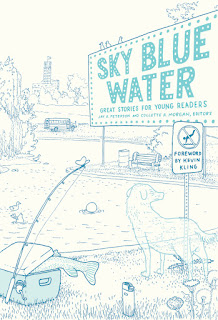
Another book is being recalled, days before its release. In this case, the book is Sky Blue Water. The error in it will be revised. The existing 4000 books are being recalled by the publisher.
 On August 28th, author Shannon Gibney, posted a photo of the page in the forthcoming Sky Blue Water that said "Christopher Columbus discovered America" on her Facebook page. She has a story in the book, which is comprised of several short stories for children in grades 4-7.
Gibney wrote to the editors about that line and a few days later, the University of Minnesota Press (it is the publisher) decided to recall the book. It is not going away forever--which is good to know--because it has some terrific writers in it, including Marcie Rendon. She's an enrolled member of the White Earth Anishinaabe Nation. Marcie's story is "Worry and Wonder." It is about a child whose placement is being deliberated under the Indian Child Welfare Act.
That "Columbus discovered America" line is in the Foreword, written by Kevin Kling. Here's the paragraph (Kindle Locations 119-122):
And yet, there it is.... uttered by Kling, and okayed by the editors... I think Kling and the editors are probably aghast with that line. How, they're probably wondering did it get there? Kling is probably wondering why he put those words in that foreword, and, the editors are wondering why they didn't notice them and ask him to revisit them.* Obviously, that line is so much a part of the American psyche that it gets said, written, and then, not heard and not seen by millions of people as a problem. An error.
I'm glad that the press is recalling the book so they can correct that error. Here's a passage from the The Star Tribune's article:
Hamilton is the assistant director of marketing.
University of Minnesota Press publishes some excellent books that I recommend to writers, editors, and book reviewers. Kim TallBear's Native American DNA and Jean O'Brian's First and Lasting are two examples. Books like this can help people learn things that aren't taught in schools--be that elementary school or a college classroom.
Thanks, Shannon Gibney, for speaking up about that line. I think it is another example of the ways that social media can be used to effect change.
I wonder what the revised Foreword will be? Will that line simply be cut? Or, will the editors use its appearance as an opportunity to tell readers about their collective blindness to the line in the first place?
High profile writers have stories in the collection. Will they, in their speaking engagements, talk about that error? I hope so! Only by having a lot of discussion of the problem will we get to a place where errors like that won't happen again.
Sky Blue Water: Great Stories for Young Readers, edited by Jay D. Peterson and Collette A. Morgan, was scheduled for release on September 15th.
*At 5:28 PM on Sept 1, 2016, Ms. Hamilton wrote to tell me the following:
Another book is being recalled, days before its release. In this case, the book is Sky Blue Water. The error in it will be revised. The existing 4000 books are being recalled by the publisher.
Gibney wrote to the editors about that line and a few days later, the University of Minnesota Press (it is the publisher) decided to recall the book. It is not going away forever--which is good to know--because it has some terrific writers in it, including Marcie Rendon. She's an enrolled member of the White Earth Anishinaabe Nation. Marcie's story is "Worry and Wonder." It is about a child whose placement is being deliberated under the Indian Child Welfare Act.
That "Columbus discovered America" line is in the Foreword, written by Kevin Kling. Here's the paragraph (Kindle Locations 119-122):
From the Boundary Waters you can canoe all the way to Hudson Bay. Some believe that the Vikings navigated from the Atlantic Ocean to Minnesota more than a hundred years before Christopher Columbus discovered the Americas. It�s possible we paddled the same waters, fought the same currents.That sentence is jarring.
I'm glad that the press is recalling the book so they can correct that error. Here's a passage from the The Star Tribune's article:
"In addition to the recall and reprint, we are going to examine how this error got by the editorial safeguards we have in place to prevent such inaccuracies from making their way into our published books," Hamilton said.
Hamilton is the assistant director of marketing.
University of Minnesota Press publishes some excellent books that I recommend to writers, editors, and book reviewers. Kim TallBear's Native American DNA and Jean O'Brian's First and Lasting are two examples. Books like this can help people learn things that aren't taught in schools--be that elementary school or a college classroom.
Thanks, Shannon Gibney, for speaking up about that line. I think it is another example of the ways that social media can be used to effect change.
I wonder what the revised Foreword will be? Will that line simply be cut? Or, will the editors use its appearance as an opportunity to tell readers about their collective blindness to the line in the first place?
High profile writers have stories in the collection. Will they, in their speaking engagements, talk about that error? I hope so! Only by having a lot of discussion of the problem will we get to a place where errors like that won't happen again.
Sky Blue Water: Great Stories for Young Readers, edited by Jay D. Peterson and Collette A. Morgan, was scheduled for release on September 15th.
*At 5:28 PM on Sept 1, 2016, Ms. Hamilton wrote to tell me the following:
The phrase "discovered the Americas" was introduced in editing and not written by Kevin Kling. It was introduced by an editor and was missed in review by the U of MN Press.
Kevin�s original sentence was: "It is believed that the Vikings navigated from the Atlantic to Minnesota over a hundred years before Columbus.�
It was changed to: "Some believe that the Vikings navigated from the Atlantic Ocean to Minnesota more than a hundred years before Christopher Columbus discovered the Americas.�She said they deeply regret that phrase, because it is inaccurate and out of step with the book. They are taking immediate steps to correct it.
Subscribe to:
Posts
(
Atom
)


