Showing posts with label cyberPD. Show all posts
Saturday, July 23, 2016
Meeting Students Where They Are: DIY Literacy Ch 5-6 #cyberPD

In both my time in the classroom in large learning communities and then in supporting readers reading intervention, I continually worked to differentiate for learners. No two learners are ever the same, and as Kate and Maggie remind us this can be challenging to balance in classrooms. Using tools like charts, demonstration notebooks, micro-progressions, and bookmarks help to not only make learning more concrete for students but also allow for greater differentiation and personalization. These tools help to develop "a sustainable practice that meets kids' needs (p. 72). Working to meet the variety of needs in a classroom takes thoughtful practice. The authors help us to see how tools can not only support students who need help, but they can also extend learning for students who need more push.
These chapters reminded us to:
- Look for signs tools are working: use, struggle, shifts, growth, engagement
- Look for signs tools can be removed: automaticity, awareness
- Build effective tools: co-create; use popular culture, metaphor, kid language, space, color, branding
- Be intentional about location
I created this visual representation of key points from the reading.

In Closing
I can't thank the #cyberPD community enough for all they have shared during this event. I'll be weeks browsing through the posts and will return throughout the year for the many ideas that have been shared.
Thanks again to this amazing cast of #cyberpd! You are inspiring! Don't forget our final chat! Next Wednesday NIGHT! pic.twitter.com/aw0bSVMHlP� Michelle Nero (@litlearningzone) July 21, 2016
My Past Posts
Becoming Strategic Chapters 3-4
DIY Literacy Tools Chapters 1-2
Friday, July 15, 2016
Becoming Strategic: DIY Literacy #cyberPD Ch 3-4
Becoming Strategic and Developing Automaticity
In chapters 3-4 there is much talk about remembering and rigor. I often find when students "don't remember" something it is more likely they don't have the strategies to work through what I'm asking them to do. When students don't appear to be working at the edge of their learning, I often find I need to help show them what is next. Both remembering and vigorous work come from understanding, strategic action, and authentic learning opportunities.
These two chapters show us how to use micro progressions (as well as charts, demonstration notebooks and bookmarks) to make teaching more explicit and help students discover the next steps in their learning. Katie and Maggie remind us (p. 62), "We encounter trouble when we teach too much to hold onto, too much to remember." They share the way tools can help students prioritize, choose essential skills, and be accountable for new learning. As we read we are reminded that adjusting our language, working together, differentiating instruction, making goals explicit, and providing authentic learning opportunities can help students work toward independence. Through these opportunities we can say to students, I "hope that you will fold some of [these] lessons into your reading forever, that some of these strategies will become a part of you (p. 58)." It's the side by side time with our community, in daily conferring, in small groups, that help us to listen and adjust our teaching.
DIY Literacy
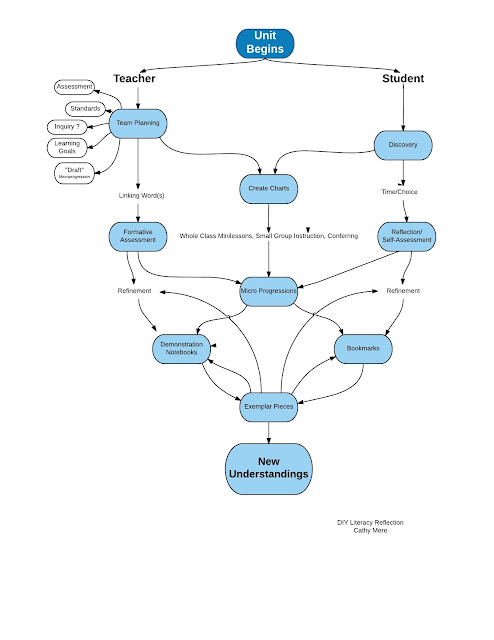
I've been trying to think through how this might look for our students in communities of inquiry. I used Lucid Charts to try to show the way tools might fit into a cycle of learning. (It's a work in progress, but I think it begins to show the way tools might fit into a unit of study and support student learning.)
This post is part of the #cyberPD book talk taking place this July. Stop by the community to read more reflections of participants.
Subscribe to:
Posts
(
Atom
)


